Custom Outdoor Clothing Manufacturing: A Category Guide for Brands
Custom Outdoor Clothing Manufacturing: A Category Guide for Brands
Custom outdoor clothing manufacturing covers a wide family of products, and each category carries its own construction logic, material requirements and compliance expectations. A brand that treats "outdoor" as one product type usually ends up with a range that looks consistent on a lookbook page but fails in the field: shells that wet out, insulated pieces that lose loft, ski pants that restrict movement. This guide maps the categories a contract manufacturer in Dongguan actually builds, explains what each category demands from pattern, fabric, insulation and testing, and shows how to structure a multi-category launch without multiplying tooling, minimums and lead time. If you are planning a Q4 or 2027 outdoor line, start with the category map below and use the checklists to brief your factory properly. You can also review the live Ginwen product range to see how these categories are commercialized.
Table of Contents
What Custom Outdoor Clothing Manufacturing Includes
Custom outdoor clothing manufacturing is the development and production of performance garments built to a brand's own specification: the brand defines fit, colorway, materials, trims, branding and packaging, and the factory converts that brief into patterns, samples, bulk production and export documentation. The category spans insulated outerwear, waterproof shells, softshell mid-layers, ski and snowboard apparel, hiking and trekking pieces, and hybrid lifestyle outerwear that borrows technical details for urban use.
At Ginwen, that work runs through an OEM and ODM model from a Dongguan facility with a minimum order quantity of 50 pieces per style, sampling in 7 to 14 days, bulk production in 25 to 40 days, sample fees of USD 50 to 200 that are deductible from the bulk order, and 30 percent deposit with 70 percent balance. Certification coverage includes ISO 9001, BSCI, RDS and OEKO-TEX. Those numbers matter because they define which categories a growing brand can realistically launch in a single season.
The Outdoor Category Map for Brand Buyers
Most outdoor assortments are built from six commercial categories. They overlap in materials but differ in how they are tested, how they are sized and how they are priced. The table below is the working map we use when a brand sends an initial brief, because it forces the buyer to state the end use, the climate band and the layering position before any pattern is opened.
| Category | Primary function | Critical construction | Typical order size | Season peak |
|---|---|---|---|---|
| Insulated puffer and down | Static warmth, packability | Baffle geometry, down-proof shell, fill control | 50-300 pcs per style | August to November |
| Waterproof shell | Rain and wind protection | Seam sealing, membrane lamination, hood engineering | 50-250 pcs per style | February to September |
| Softshell and mid-layer | Breathable movement layer | Bonded fleece, four-way stretch, cuff and hem sealing | 50-300 pcs per style | Year-round |
| Ski and snowboard | Cold and snow protection with mobility | Articulated knees, powder skirts, reinforced hems | 50-200 pcs per style | June to October |
| Hiking and trekking | Weight balance and ventilation | Vent zips, harness-compatible pockets, abrasion panels | 50-250 pcs per style | January to June |
| Technical lifestyle | City wear with outdoor details | Clean seam lines, hidden hardware, softer hand feel | 50-400 pcs per style | Year-round |
The order sizes in that table are not arbitrary. They reflect the point at which fabric minimums, trim minimums and cutting efficiency start to work in the brand's favor. Below roughly 50 pieces per style, fabric minimums and cutting waste dominate the unit cost. Between 50 and 300 pieces, a factory can absorb the setup work and still give the brand a workable landed cost. Above 300 pieces, the conversation shifts to dedicated lines, custom-developed fabrics and seasonal capacity reservation.
Six Core Categories and What Each One Demands
The category map is useful for planning an assortment. The next level of detail is what each category requires from a manufacturing partner. These are the questions that separate a factory that can build outdoor product from a factory that only sews jackets.
1. Insulated Puffer and Down Jackets
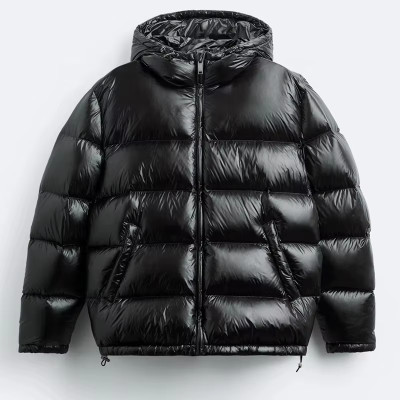
Insulated outerwear is the category most brands start with, and the one where small construction decisions have the largest commercial effect. The core variables are fill power, fill weight, baffle construction and shell fabric. Sewn-through baffles are lighter and cheaper but create cold spots along every stitch line. Box-wall or stitchless construction removes those cold spots and adds cost and weight. A brand selling into a cold climate should specify the construction explicitly rather than accepting whatever the factory proposes.
Down-proof shell fabric matters as much as the fill. A shell with insufficient density or coating will let down migrate through the seams and emerge on the surface, which becomes a customer service issue within weeks. Look for tightly woven nylon or polyester with a documented down-proof finish, and ask how the factory tests leakage after filling. For synthetic fills, the questions shift to fiber type, loft recovery after compression cycles and how the insulation behaves when wet. Our custom down jacket program covers both natural and synthetic fills, and the down jacket manufacturer page explains the material options in more detail.
2. Waterproof Shells and Rainwear
Waterproof shells are a construction discipline more than a fabric purchase. A membrane is only as good as the seams that join it. Every seam in a waterproof garment has to be taped, and every tape has to be applied at the correct temperature and pressure for that specific laminate. A factory that tapes seams without a controlled machine setting will produce shells that pass a visual inspection and fail in the rain.
The second discipline is hood engineering. A hood that does not move with the head, or that cannot be cinched without pulling the face opening closed, will be returned. Ask for the hood pattern, the number of adjustment points and how the brim is stiffened. The third is the front closure: a storm flap behind the zipper, a chin guard that does not rub, and a hem that can be tightened without exposing the lining. For brands entering this category, the custom waterproof jacket range shows the standard component set.
3. Softshell and Technical Mid-Layers
Softshell is the category that most often gets treated as a fashion item and then fails as a performance item. The functional requirements are breathability, four-way stretch and a durable water repellent finish that survives washing. Bonded three-layer softshell with a fleece backer is the most common construction for colder markets, while two-layer bonded fabric is lighter and better for active use.
Pattern work matters here more than in any other category. A softshell jacket that lifts at the hem when the wearer reaches overhead, or that pulls across the back in a climbing position, has a pattern problem that no fabric upgrade will fix. Ask the factory to build the sample with a reach test and a squat test in the size range, not just a standing fit model. Cuff closures, hem gripper elastic and sleeve articulation are the details that determine whether the garment is worn or left in a pack.
4. Ski and Snowboard Apparel
Ski and snowboard apparel is the most demanding category in the outdoor family because it combines insulation, waterproofing and extreme range of motion. Ski jackets need a helmet-compatible hood, a powder skirt that connects to the pants, wrist gaiters, and pockets placed where a harness or backpack strap will not block them. Ski pants need articulated knees, reinforced insteps and a hem that sits over a boot without dragging.
The testing standard is different too. Garments are evaluated in cold conditions, so materials that feel fine at room temperature can stiffen noticeably below freezing. Ask the factory which fabrics have been used in cold-weather programs before, and request a cold-flex check on any coated or laminated material. Waterproof ratings for ski outerwear are usually specified higher than for city rainwear, and seam sealing must extend to the crotch and knee curves where stress is highest. Brands building this category should plan for a longer development cycle, because a ski sample typically needs at least two fit rounds before approval.
5. Hiking and Trekking Clothing
Hiking and trekking pieces prioritize ventilation, weight and abrasion resistance over absolute warmth. The key construction features are pit zips or back vents, harness-compatible chest pockets, articulated sleeves, and reinforcement panels at the shoulders where a pack strap rubs. Fabric choice usually favors nylon or polyester ripstop with a soft hand feel, because the garment may be worn directly against the skin in warm conditions.
This is also the category where the factory's pattern grading shows. Hiking apparel is sold in a broader size range than fashion outerwear, and a pattern that was graded from a slim fit will not work for a market that expects room through the chest and shoulders. Ask how many sizes the pattern is graded to, whether the grading is done in-house, and whether the fit model reflects the target market rather than the local sample size. Our mountaineering and hiking clothing range shows how these construction details are combined in a single program.
6. Technical Lifestyle and Hybrid Outerwear
Hybrid outdoor pieces take performance construction and soften it for daily wear. The category includes city puffers with taped critical seams, softshell overshirts, insulated vests worn over knitwear, and rain shells cut with a longer, cleaner silhouette. The commercial appeal is obvious: the consumer gets weather protection without looking like they are heading to a trailhead.
The manufacturing challenge is restraint. Every technical feature that is added has to justify itself visually as well as functionally. Hidden zippers, clean seam lines, matte hardware and tonal branding usually outperform visible technical detailing in this category. Colorways tend to be more muted, and fabric hand feel matters more than lab-rated performance because the garment is worn in the city. Brands often run this category as a bridge between a fashion line and a technical line, which means the factory has to be comfortable working with both a technical brief and a fashion calendar.
Fabric and Insulation Selection Matrix
Material selection is where most of the product cost and most of the performance risk sit. The matrix below is a starting point for briefing, not a substitute for lab testing. Each row represents a common commercial choice and the trade-off a brand accepts when it selects it.
| Material family | Best used for | Strength | Trade-off |
|---|---|---|---|
| Nylon ripstop, 20D-40D | Lightweight puffers, packable insulation | High strength-to-weight ratio, good down-proofing | Thinner hand feel, higher fabric cost |
| Polyester taslan or twill | Mid-price puffers, lifestyle outerwear | Durable, good color depth, lower cost | Heavier, less compressible |
| Recycled polyester plain weave | Brands with sustainability commitments | Documented recycled content, good printability | Supply variability, certification paperwork |
| 2-layer laminated shell | Rainwear, entry-level waterproof jackets | Lighter, more flexible, lower cost than 3-layer | Requires lining, less durable inner face |
| 3-layer laminated shell | Ski shells, premium waterproof jackets | Durable, no lining needed, high performance | Highest fabric cost, stiffer hand feel |
| Bonded softshell, 3-layer | Mid-layers, active outerwear | Stretch, breathability, wind resistance | Limited seam-sealing options |
| Down, 550-800 fill power | Premium insulated outerwear | Best warmth-to-weight ratio | Moisture sensitivity, RDS documentation |
| Synthetic insulation | Value puffers, wet-climate programs | Retains warmth when damp, easier care | Bulkier, lower loft recovery |
Two rules save brands from expensive mistakes. First, do not mix a premium shell with a budget insulation system or the reverse; the garment will either underperform or be overpriced for its market. Second, confirm that the fabric and the trim are compatible before sampling. Zippers, tapes and threads are specified for a particular fabric weight and finish, and a mismatch usually shows up as puckering, wicking or tape failure after the first wash.
Compliance Mapping by Market
Compliance requirements differ by market and by retailer, and they are checked at the factory level rather than the brand level. A brand cannot inherit a factory's certification by mentioning it on a website; the certificate has to cover the specific production site and the specific material scope. The four certifications that appear most often in outdoor sourcing conversations are ISO 9001, BSCI, RDS and OEKO-TEX.
ISO 9001
A quality management system certification. It indicates documented process control, inspection records and corrective action procedures. Buyers use it as a baseline signal that the factory can reproduce a specification across orders.
BSCI
A social compliance audit covering working conditions, hours, wages and safety. European retail chains and marketplaces increasingly require a current audit report before onboarding a supplier.
RDS
The Responsible Down Standard traces down through the supply chain and prohibits live plucking and force feeding. Any brand selling down product into Europe or North America should expect a documentation request.
OEKO-TEX
Tests for harmful substances in fabrics, threads and trims. It is a material-level certification, so the certificate must list the specific fabric and colorway, not just the factory.
Beyond certifications, three practical compliance items cause most shipment delays. The first is the care label: fiber content, washing instructions and country of origin must match the actual bill of materials. The second is chemical compliance for the destination market, which may require specific test reports for azo dyes, formaldehyde or PFAS restrictions. The third is packaging and labeling compliance, including recycling marks and retailer-specific carton labeling. A factory that handles export programs routinely will have a standard document pack for these items; a factory that only serves the domestic market will not.
How an Outdoor Development Program Actually Runs
Development is a sequence, and each stage produces a decision that the next stage depends on. Compressing the sequence is possible, but skipping it is not. The timeline below reflects a standard program at Ginwen with sampling in 7 to 14 days and bulk production in 25 to 40 days after approval.
Brief and category definition
One to three days. End use, climate band, layering position, target retail price, size range and order quantity are confirmed in writing.
Technical pack and material selection
Two to five days. Pattern block, measurement chart, bill of materials, colorways and branding placement are drafted and reviewed.
Sample development
Seven to fourteen days. Fabric and trim sourcing, pattern cutting, first sample sewing and internal fit review.
Fit and construction review
Three to seven days per round. Fit model evaluation, construction corrections, material substitutions and cost review.
Pre-production approval
Two to four days. Approved sample, signed specification sheet, size set and lab dip confirmation before bulk fabric is cut.
Bulk production
Twenty-five to forty days. Cutting, sewing, filling or bonding, in-line inspection and final audit.
Packing and export
Three to seven days. Carton packing, labeling, documentation and handover to the freight forwarder.
Typical total: six to ten weeks from approved brief to ex-factory, excluding sea freight.
Two scheduling details are worth planning around. First, sample rounds multiply. A ski program with a helmet-compatible hood and articulated pants often needs three rounds, which adds two to three weeks. Second, fabric lead time sits outside the production window. If a fabric has to be developed or dyed to a specific color, add two to four weeks before sampling can start. Brands that lock the fabric in August for a November launch consistently have an easier season than brands that approve the fabric in September. More detail on sequencing appears in our manufacturing guides.
MOQ, Sampling Fees and Cost Drivers
Outdoor programs have a different cost structure from fashion outerwear because the performance components are expensive and the testing is more demanding. The efficient way to budget is to understand which line items move the unit cost and which are fixed. Fixed costs include pattern development, sample making, grading and packaging artwork. Variable costs include fabric, insulation, trims, labor, testing and freight.
At a 50-piece minimum per style, fixed costs are spread across a small run, so they represent a larger share of the unit price than they would at 500 pieces. That is normal and not a reason to avoid small runs. The important thing is to plan the range so that multiple styles share the same fabric, the same zipper family and the same insulation, which spreads the material minimums and reduces cutting waste. A brand that launches three puffer styles from one shell fabric and one down lot will usually land at a lower blended cost than a brand that launches three unrelated fabric stories.
Cost drivers to control
- Fill power and fill weight in insulated styles
- Membrane type and seam-sealing coverage
- Number of pattern pieces and panel splits
- Custom hardware and branded pulls
- Color count per style and per fabric
- Testing scope required by the retailer
Terms to confirm in writing
- 50 pieces per style minimum order
- Sample fee of USD 50 to 200, deductible from bulk
- Sampling lead time of 7 to 14 days
- Bulk lead time of 25 to 40 days after approval
- 30 percent deposit, 70 percent before shipment
- Inspection and documentation responsibilities
Payment structure matters for cash flow planning. A 30 percent deposit with 70 percent balance before shipment is standard for export manufacturing and ties the final payment to pre-shipment inspection. Brands should confirm what happens if the inspection finds a defect rate above the agreed limit, and whether rework time is built into the delivery schedule. It is also worth agreeing on how sample fees are credited: some factories deduct the fee from the first bulk invoice, others refund it after shipment. Get the mechanism in the purchase order, not in an email thread.
Quality Gates That Matter in Outdoor Outerwear
Outdoor quality control is not a final inspection problem. It is a set of gates placed at the points where failure becomes expensive. The gates below are the ones that consistently catch defects before they reach a carton.
| Gate | What is checked | Why it matters |
|---|---|---|
| Fabric inspection | Shade continuity, weight, coating uniformity, defects per roll | Prevents panel-to-panel color variation in the finished garment |
| Cutting audit | Panel count, grain alignment, notch matching, size set | Catches patterning errors before sewing labor is committed |
| In-line sewing check | Stitch density, seam allowance, baffle alignment, tape application | Detects construction drift early in the run |
| Filling and bonding check | Fill weight per panel, down leakage, laminate bubbles | Directly affects warmth, appearance and waterproof performance |
| Final inspection | Measurement against spec, hardware function, labeling, packing | Confirms the shipment matches the approved sample |
Three tests are worth requesting explicitly for outdoor programs, because they target the failure modes that customers actually report. The first is a seam-seal integrity check on waterproof styles, performed on a finished garment rather than a swatch. The second is a down-leakage check after filling, which involves compressing the garment and inspecting the shell surface. The third is a hardware cycle test on the main zipper, because a zipper that fails at the collar makes the whole garment unwearable.
Planning a Multi-Category Range Without Multiplying Complexity
A brand entering outdoor usually wants to cover more than one category in the first season. The instinct is to build a complete collection: a puffer, a shell, a softshell, a ski set and a vest. The commercial reality is that each category has its own sample cycle, its own testing requirements and its own material minimums, so a five-category launch can consume an entire development calendar.
A more workable approach is to build around a shared platform. Choose one shell fabric family, one insulation specification and one trim family, then express the range through silhouette and colorway rather than through material variety. A men's and women's puffer built on the same baffle logic, a vest derived from the same pattern block, and a hooded and hoodless version of the same shell can create the impression of a broad range while sharing most of the development work.
Sequence the categories by risk. Start with the category the factory has the most evidence in, then add the adjacent category in the next development slot. A brand that begins with an insulated puffer and adds a waterproof shell in the following cycle learns how the factory communicates before committing to the most technically demanding product. Ski apparel should come after the brand has a working shell and insulation program, not before, because it combines both disciplines in one garment.
A Twelve-Point Sourcing Checklist
Use this checklist before placing a sample order. Each item should have a written answer, not a verbal assurance. The questions are deliberately blunt because vague answers at this stage become expensive surprises later.
- Which categories have you produced in the last twelve months, and can you share construction details without client names?
- What is your minimum order quantity per style, and does it change by fabric or by color?
- How long does a first sample take, and how many fit rounds are included in that timeline?
- What is the sample fee, and how is it credited against the bulk order?
- Which fabrics and insulation types do you stock, and which require development?
- Can you show the certificate scope for ISO 9001, BSCI, RDS and OEKO-TEX as applicable?
- Who owns the pattern and the technical pack after development?
- How do you control shade continuity across panels and across repeat orders?
- What in-line quality checks are performed, and who signs off at each gate?
- What is the defect policy, and how is rework scheduled against the delivery date?
- What are the payment terms, and which documents are issued before shipment?
- Who is the single point of contact for development, and what is the response window?
A factory that answers all twelve clearly is usually a factory that has handled export programs before. A factory that answers three and deflects the rest is a factory that will manage the gaps during production, which is exactly when the brand has the least leverage. If you want to benchmark a brief before committing, you can send your requirements and ask for a category-specific response rather than a general catalog.
Frequently Asked Questions
What is the minimum order for custom outdoor clothing?
At Ginwen the minimum is 50 pieces per style. That applies across insulated jackets, shells, vests and ski pieces, though fabric minimums may require a higher quantity for a specific color or a newly developed material.
Can one factory produce both down and synthetic insulated jackets?
Yes. The construction logic is similar, but the filling equipment, the down-proof shell requirement and the testing differ. Ask the factory to confirm which filling method it uses and how it controls fill weight per baffle.
How long does a custom outdoor program take from brief to delivery?
Sampling takes 7 to 14 days, bulk production takes 25 to 40 days after sample approval, and packing adds a few days. A realistic planning window is six to ten weeks ex-factory, plus sea freight for the destination market.
Do you support OEM and ODM development?
Both. OEM means the brand supplies the design and specification and the factory builds to it. ODM means the factory contributes pattern blocks, material recommendations and construction improvements based on existing product architectures.
Which certifications should a brand request for outdoor outerwear?
ISO 9001 for quality systems, BSCI for social compliance, RDS for down traceability and OEKO-TEX for material safety. The exact set depends on the destination market and the retailer's vendor requirements.
Can a small brand start with one style and expand later?
Yes, and it is usually the better sequence. Starting with one category at 50 to 100 pieces gives the brand a real production reference, a tested fit block and a working relationship before adding the next category.
Custom outdoor clothing manufacturing works best when the category is chosen before the fabric and the factory is briefed before the sample. Insulated outerwear, waterproof shells, softshell mid-layers, ski apparel, hiking pieces and technical lifestyle garments each carry a different construction logic, and a partner who understands that difference will save more money than a lower quotation ever will.
If you are building an outdoor range for the next season, contact the Ginwen team with your category, target market and quantity, or submit a detailed inquiry for a category-specific quotation. You can also review the custom puffer jacket program, the puffer vest range or the full product catalog before you brief.