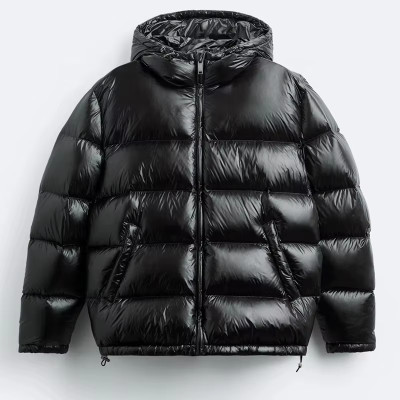
Private Label Down Jacket Manufacturing Guide | OEM & ODM Services for Custom Outerwear Brands
Private Label Down Jacket Manufacturing Guide
Private label down jacket manufacturing is the process of producing a finished down jacket under your own brand, using your labels, your packaging and your own size specification, while the factory handles pattern development, material sourcing, insulation filling, sewing, quality control and bulk shipment. The model lets a brand sell a technically demanding cold-weather product without owning cutting tables, quilting machines or a filling line. What it does not remove is the need to control specifications. This guide covers the complete private label workflow for down jackets: the brand and product brief, fill and shell specifications, pattern development and sampling, sample-to-bulk consistency, MOQ 50 pcs per style, branding and packaging, compliance documents, the 25 to 40 working day bulk timeline, payment terms and the quality gates that decide whether your second order is easier than your first. The terms described here match the ones published on our OEM and ODM service page.
Table of Contents
- What Private Label Really Means
- Fill and Shell Specifications
- The Brand and Product Brief
- Pattern Development and Sampling
- Sample-to-Bulk Consistency
- How MOQ 50 pcs per Style Works
- Branding, Labels and Packaging
- Certifications and Documents
- Bulk Timeline and Payment Terms
- How Ginwen Supports Your Program
- Frequently Asked Questions
What Private Label Down Jacket Manufacturing Really Means
Private label, OEM and ODM are often used as if they were interchangeable. They are not. The distinction matters because it decides who owns the pattern, who carries the development cost and how quickly you can change a design between seasons. In private label production, the brand owns the product identity and the factory owns the production capability. In ODM production, the factory also contributes the original design, which is then adapted with your branding.
Down jackets are a category where the difference shows up quickly. A down jacket is not a printed t-shirt: baffle layout, fill distribution, shell weight and seam sealing all change the warmth-to-weight ratio the consumer feels. That is why most brands entering the category start with a defined private label program rather than a fully open design brief. If you already sell a custom down jacket range or plan to, the specification stack described in the next section is the part you cannot skip.
| Production Model | Who Owns the Design | What the Factory Provides | Typical Use |
|---|---|---|---|
| Private label | Brand owns the design and the label | Pattern, sourcing, production, QC | Brands scaling a proven silhouette |
| OEM | Brand supplies tech pack and artwork | Engineering, sampling, bulk, packing | Brands with in-house design teams |
| ODM | Shared: factory base design, brand adaptation | Design library, patterns, branding changes | Fast entry into a new category |
Where Private Label Sits Between OEM and ODM
In practice, most private label down jacket programs sit between the two extremes. The brand defines the fit, the fill grade, the shell hand feel and the branding, while the factory applies an existing block pattern and adapts it. This keeps development realistic: you get a jacket that has already been engineered for filling and quilting, and you still control the details that customers see and touch. The practical question is not which label to use, but which specifications you are prepared to freeze before sampling starts.
Fill and Shell Specifications Buyers Must Fix Before Sampling
Every private label down jacket decision ultimately reduces to two material blocks: what goes inside the baffles and what holds it there. Fix both before a pattern is cut, because changing fill grade after sampling resets the quilting density, the baffle height and often the whole cost structure.
The Insulation Block
Down is graded by fill power, which measures how much volume one ounce of down occupies. Higher fill power traps more air for the same weight, so a 700 fill jacket can be lighter and warmer than a 550 fill jacket of similar bulk. Buyers usually choose between duck down and goose down, natural or recycled down, and between a pure down fill and a down and feather blend. Recycled down and responsibly sourced down are now requested routinely by European and North American retailers, and they must be supported by traceable documentation rather than a verbal assurance.
The Shell and Trim Block
Shell fabric decides water resistance, hand feel and how premium the jacket looks on a shelf. Nylon ripstop and high-denier nylon are common for technical jackets, while polyester blends serve fashion-oriented programs at lower cost. A durable water repellent finish, taped seams and waterproof zippers are separate specifications, not automatic inclusions, so they must be written into the brief with the exact level of protection you expect.
Fill Grade
550 to 900 fill power, duck or goose, natural or recycled. Higher fill power raises cost but reduces jacket weight and improves packability.
Shell Fabric
Nylon ripstop, high-denier nylon, polyester blends. Choose by abrasion resistance, hand feel and the retail price tier you are targeting.
Weather Protection
DWR finish, seam sealing, waterproof zippers and storm flaps can each be added or removed. Specify them individually.
Trims and Hardware
Zippers, snaps, elastic cuffs, drawcords and lining fabrics are branding opportunities and cost variables at the same time.
The Brand and Product Brief That Keeps a Program on Track
A private label down jacket project fails more often at the brief stage than at the sewing stage. When the brief is vague, the sample comes back looking acceptable but feeling wrong, and every correction costs a week. The brief does not need to be long. It needs to be specific about the elements that are expensive to change later.
What the Brief Must Contain
- Target market and retail price band, including the currency and the expected sell-through season.
- Silhouette reference: length, fit through the chest and waist, hem shape, sleeve length and collar or hood construction.
- Fill specification: fill power, fill weight per size, down or down and feather ratio, and the traceability standard required.
- Shell, lining and trim specification, including colour references and any surface finish requirement.
- Size range and grading rules, with a measurement table for at least the base size and the two extremes.
- Branding list: main label, care label, size label, hangtag, packaging and any logo application method.
- Compliance documents that the factory must supply with the shipment.
- Estimated first order quantity by style and colour, plus a reorder forecast for the following season.
A brief built this way has a second benefit: it becomes the reference document for quality inspection. Inspectors can only confirm what has been written down, so every measurable requirement in the brief turns into a checkable point at pre-production, inline and final inspection.
Pattern Development and Sampling: Where the Standard Is Set
Sampling is the stage where your private label down jacket stops being a document and becomes a physical product. For a down jacket the process normally runs through five stages, and each one has a clear output that the next stage depends on.
Specification Review
2 to 4 working days. The factory reviews the brief and measurement table, flags conflicts and confirms the fill weight that fits the baffle height.
Pattern Development and Grading
CAD pattern, then grading across the full size range with the agreed increments for chest, waist, sleeve and body length.
Prototype Sample
7 to 14 working days. Fabric and fill are sourced, cut and assembled so fit and warmth distribution can be evaluated on a real garment.
Fit Review and Revision
Measurements are checked against the brief. Revisions are logged so the next round starts from a known baseline.
Approved Sample and Pre-Production Standard
The signed sample becomes the reference for bulk. Nothing is produced before this approval.
Sampling standard: 7 to 14 working days per round, sample fee USD 50 to 200 deductible from the bulk order.
Sample Approval Checklist
Before approving a private label sample, check five things in order. First, measure the garment flat and compare every point against the brief measurement table. Second, check fill distribution by hand along the baffles; cold spots and thin shoulders are a fill-weight or quilting problem, not a cosmetic one. Third, test the closures and hardware through full movement. Fourth, confirm that all branding elements are present at the agreed size and position. Fifth, confirm the label content that will be printed, because care and fibre content wording is regulated in most destination markets. Approving on appearance alone is the most common and most expensive mistake in private label production. Programs where the brand supplies the complete tech pack follow the same five checks inside our OEM and ODM service workflow.
Sample-to-Bulk Consistency: The Real Test of a Factory
Any factory can produce one good sample. Private label programs live or die on whether unit five hundred matches unit one. Down jackets are especially sensitive because small deviations in fill weight, baffle spacing or shell tension change the visual bulk of the jacket, which customers notice immediately on a rack of identical products.
Consistency is controlled through gates, not through goodwill. A workable private label quality plan uses four gates: pre-production inspection of fabric, fill and trims against the approved standard; inline inspection during cutting and assembly to catch pattern or fill drift early; final inspection on finished goods using an agreed acceptance level; and a packaging check that confirms labels, hangtags and polybag content before cartons are sealed.
Pre-Production
- Fabric and lining shade check
- Fill grade and fill weight check
- Trim and hardware confirmation
- Approved sample on the line
Inline
- Pattern and measurement drift
- Quilting and baffle spacing
- Stitch density and seam sealing
- Fill distribution per panel
Final Inspection
- Measurement audit per size
- Workmanship and hardware test
- Branding position and content
- Carton and packing list check
Documentation
- Inspection reports per order
- Material certificates on file
- Shipment packing list
- Traceability records for fill
How MOQ 50 pcs per Style Works for Private Label Down Jackets
Minimum order quantity is usually the first constraint a growing brand meets, and it is also the most misunderstood. Our current standard is MOQ 50 pcs per style, counted per style and per colour, with mixed sizes inside that quantity. That structure exists because cutting and quilting are set up per style and per colour, not per size.
| Order Size | What It Is Suited To | How It Is Counted |
|---|---|---|
| 50 pcs | First production run, fit validation at retail, capsule launch | Per style, per colour, sizes mixed |
| 150 to 300 pcs | Seasonal range with two or three colours | Per style and colour, graded curve |
| 500 pcs and above | Full seasonal programs and reorders | Consolidated by style family |
A first order of 50 pcs per style is enough to test the silhouette, the fill grade and the price point in a real sales channel without locking capital into inventory. It also produces a measured sell-through signal that makes the second order far easier to plan. Brands that have not yet fixed their first silhouette can compare fill levels and constructions in the product catalogue before writing the brief. Reorders usually repeat the approved sample, so they skip pattern development and sampling entirely, which shortens the lead time noticeably.
Branding, Labels and Packaging: The Visible Part of Private Label
Branding is what separates a private label down jacket from a stock garment, and it is also where compliance and presentation meet. A jacket can be technically perfect and still be unsellable if the care label content is wrong or the hangtag contradicts the market's labelling rules.
Woven and Printed Labels
Main label, size label and care label with fibre content, care instructions and country of origin. Content wording should be confirmed for the destination market.
Logo Application
Embroidery, woven patch, rubber patch, heat transfer or screen print. Each method has a different durability and cost profile on down-filled panels.
Packaging
Polybags, barcoded hangtags, size stickers, tissue and retail boxes. Packaging artwork must be supplied as production-ready files.
Retail Presentation
Folding method, hanger compatibility and polybag air evacuation all affect how the jacket looks when it is unpacked in store or at a fulfilment centre.
Because branding components are ordered separately from shell fabric, they set their own lead time. A private label program that expects custom woven labels and printed packaging should include those approvals in the same cycle as the sample, not after it. Keeping branding on the critical path is one of the simplest ways to protect the 25 to 40 working day bulk window.
Certifications and Documents to Collect From Your Factory
Compliance documents are requested earlier and checked more strictly than most first-time buyers expect. Retail platforms, importers and larger wholesale accounts increasingly ask for evidence before the purchase order is confirmed, not at the port.
ISO 9001
Quality management system certification. It supports consistent process control across repeated orders and is commonly requested by professional procurement teams.
BSCI and SEDEX
Social compliance audits covering working conditions and ethical manufacturing. Many European retail chains treat these as a baseline requirement.
RDS
Responsible Down Standard validates traceability and animal welfare across the down supply chain. It applies to the fill, so it must match the down actually used in your order.
OEKO-TEX
Testing standard confirming that fabrics, linings and trims are free from harmful substances at the tested limit values.
Keep a document folder per order containing the specification sheet, approved sample record, material certificates, inspection reports and the packing list. When a buyer, a platform or a customs broker asks a question six months later, that folder answers it in minutes instead of days.
Bulk Production Timeline and Payment Terms
Once the sample is approved, the private label down jacket moves into a predictable sequence. The timeline below reflects our current production standard for a 50 pcs per style order and scales with quantity rather than restarting from scratch.
Order Confirmation
Purchase order, proforma invoice, 30% deposit, and material booking against the approved specification.
Material Preparation
Shell fabric, lining, fill and trims are inspected and matched to the approved standard before cutting begins.
Cutting and Quilting
Panels are cut, baffles are formed and fill is distributed by panel weight rather than by eye.
Assembly and Finishing
Sewing, sealing, hardware fitting, labelling and pressing, with inline checks against the approved sample.
Final Inspection and Shipment
Final audit, packaging confirmation, 70% balance, carton marking and handover to the agreed freight method.
Standard lead time: 25 to 40 working days of bulk production after sample approval, plus transit.
Payment Terms in Practice
Our standard terms are 30% deposit on order confirmation and 70% balance before shipment, after final inspection. This structure funds material booking at the start and settles the balance against a verifiable finished order. Sample fees of USD 50 to 200 are charged per round and are deductible from the bulk order, so development work is not an additional sunk cost once production proceeds. Confirming these terms in writing before cutting starts prevents almost every payment dispute we see.
How Ginwen Supports Custom Outerwear Brands
Ginwen manufactures custom down jackets, puffer jackets, parkas, padded jackets and insulated hybrid outerwear for brands, wholesalers, private label programs and retail groups in Europe, North America and other export markets. The production model is built for buyers who need low minimums at the start and dependable scale later.
In practical terms, the support covers in-house pattern development and grading, fill and shell sourcing, sampling with reported revision rounds, controlled bulk production, quality inspection at each gate, and full private label branding. Certification coverage includes ISO 9001, BSCI and SEDEX social compliance, RDS for down traceability and OEKO-TEX for material safety testing. Buyers can start from a single approved sample and scale, or supply a complete tech pack for OEM production through our OEM and ODM service.
If you are still selecting the product itself, browsing a category page such as our custom down jacket range is usually faster than starting from a blank specification, because it shows the silhouettes and fill levels already in production. For a broader view of outerwear options, see the product catalogue, and for company background and production capability see the about us page.
Frequently Asked Questions
What is the difference between private label and OEM down jackets?
In private label production the brand owns the product identity and the factory produces to that specification under the brand's own labels. In OEM production the brand supplies a completed tech pack, including patterns and artwork, and the factory manufactures exactly to it. Both models use the same production lines; the difference is how much of the design documentation the brand provides.
What is the minimum order quantity for private label down jackets?
Our current standard is MOQ 50 pcs per style, counted per style and per colour, with mixed sizes inside that quantity. This makes a first production run practical for a new silhouette before committing to a full seasonal program.
How long does private label down jacket production take?
Sampling runs 7 to 14 working days per round. After sample approval, bulk production takes 25 to 40 working days depending on quantity, fill grade and branding complexity. Transit time is additional and depends on the shipping method chosen.
Can I use my own brand labels, hangtags and packaging?
Yes. Private label production includes your main label, size label, care label, hangtags and packaging. Care and fibre content wording should be confirmed against the labelling rules of your destination market before bulk printing.
Do you produce with RDS certified down?
Yes. RDS certified down is available and the certificate must correspond to the down actually used in your order. We also hold ISO 9001, BSCI and SEDEX social compliance, and can supply OEKO-TEX testing documentation for fabrics, linings and trims.
How are sample fees handled?
Sample fees range from USD 50 to 200 per round depending on fabric, fill complexity and branding. They are deductible from the bulk order once production is confirmed, so development cost is recovered when the program proceeds.
What payment terms apply to bulk orders?
The standard structure is 30% deposit on order confirmation and 70% balance before shipment after final inspection. Terms are confirmed in writing on the proforma invoice before cutting begins.
Can sizes and colours be mixed within the minimum order quantity?
Sizes are mixed freely inside a style and colour. Colours are counted separately because cutting and quilting are set up per colour, which is why the minimum applies per style and per colour rather than to the whole order.
Private label down jacket manufacturing rewards preparation. Fix the fill and shell specification early, write a brief that inspectors can measure against, treat the approved sample as the contract, and control consistency through gates rather than assurances. Do that and MOQ 50 pcs per style becomes an advantage: a controlled first order that produces a real sales signal instead of a warehouse risk.
To move from reading to production, send us your specification with your target quantity, size range and branding requirements, or contact our team to discuss your private label down jacket program. You can also review the OEM and ODM service scope or continue reading more jacket manufacturing guides.
Visual Reference
- [IMAGE_PLACEHOLDER]
- English prompt: factory floor photo of a down jacket filling and quilting line, operators measuring fill weight per baffle panel, industrial lighting, no text overlay.
Visual Reference
- [IMAGE_PLACEHOLDER]
- English prompt: close-up of a private label jacket care label and woven main label on a navy nylon down jacket, shallow depth of field, neutral background.
Visual Reference
- [IMAGE_PLACEHOLDER]
- English prompt: final inspection table with two down jackets laid flat, measuring tape across the chest and a measurement table sheet beside them, clean workshop bench.