Luxury Down Manufacturing
Private Label Luxury Down Jackets: A Positioning Triangle for Premium Brands
A private label luxury down jacket is not simply a standard down jacket with a higher price tag. It is the result of three specification decisions made at the same time: the fill, the shell, and the finishing. Get the fill ratio and fill power right, engineer a high-density shell that feels expensive in the hand, and control the hand-finishing steps that customers can feel through touch and wear, and a program can support premium retail positioning. Miss any one of the three and the product reads as mid-market no matter how much it costs to produce. This guide is written for brand owners, founders, and sourcing managers who are planning a private label luxury down jacket line and need a practical way to specify it. It explains the positioning triangle, breaks down what each upgrade step contributes, and shows what to put in a tech pack before you request samples from a factory. For a broader manufacturing overview, see our private label down jacket manufacturing guide.
The Luxury Positioning Triangle: Three Pillars That Justify a Premium Price
Luxury down jackets are usually discussed as a materials problem, but materials alone do not create positioning. A jacket only reads as luxury when the fill spec, the shell fabric, and the finishing quality are aligned. That alignment is what we call the positioning triangle. Each corner supports the other two. A high fill power inside a shiny, crunchy shell looks like a downgrade. A beautiful shell filled with thin, feathery down feels hollow once a customer touches it. And perfect materials finished with loose threads and uneven quilting destroy trust at the point of sale.
When buyers evaluate private label luxury down jackets, they should evaluate all three corners with the same test: can the customer perceive this upgrade during a three-second touch test? Upgrades that cannot be perceived are usually production cost without positioning value. The triangle exists to stop brands from paying for invisible quality, which is one of the most common and expensive mistakes in premium outerwear development.
3
Pillars in the Positioning Triangle
95/5
Typical Luxury Down-to-Feather Ratio
50
Pieces per Style Minimum Order
7-14
Days for Sampling
Pillar One: Fill Spec
The down-to-feather ratio, fill power, and fill weight decide loft, warmth-to-weight ratio, and how the jacket feels when compressed. This is the least visible corner at first touch but the most measurable one. See our guide to what fill power means in down jackets.
Pillar Two: Shell Hand
Fabric density, surface finish, and drape decide whether the jacket feels expensive the moment a customer picks it up. Shell choice also controls down-proof performance and how quietly the garment moves.
Pillar Three: Hand Finishing
Quilting regularity, trim attachment, seam cleanliness, and final pressing are where mass production and premium production look most different. These steps are reviewed at sampling, not after bulk.
Tip: Before you brief a factory, decide which corner of the triangle your brand will actually market. Most premium brands can only defend one or two corners with credible storytelling. Specifying all three at maximum level raises cost without necessarily raising perceived value.
Pillar One: Specifying a 95/5 Goose Down Fill the Right Way
The fill spec is the foundation of a luxury down jacket. In practice, a premium specification combines a high down-to-feather ratio, a high fill power, and a fill weight that matches the intended climate and silhouette. A 95/5 specification means 95 percent down clusters and 5 percent feathers, which supports better loft, softer hand feel, and more efficient warmth per gram than lower-ratio fills. This is why luxury programs typically start at 90/10 and move toward 95/5 as positioning moves upmarket.
Fill power is the second half of the same decision. Fill power describes how much volume one unit of down occupies, and it is the standard way buyers compare insulation quality between suppliers. Higher fill power means more loft for the same weight, which allows a thinner, lighter jacket for the same warmth. For luxury positioning, the combination of ratio and fill power matters more than either number alone, which is why buyers should always request both on the spec sheet. Our article on duck down versus goose down explains the trade-offs in more detail.
| Spec Layer | What It Controls | Why Luxury Programs Specify It | What to Verify |
|---|
| Down-to-feather ratio | Loft, softness, warmth-to-weight | Higher down content supports a softer hand and more stable loft | Ratio printed on the down report from the supplier |
| Fill power | Volume per unit weight | Allows a lighter garment at the same warmth level | Measured fill power on the lot, not a catalogue value |
| Fill weight per panel | Warmth distribution by zone | Prevents cold spots that premium customers notice | Fill card for each panel and garment size |
| Cleanliness and odor | Comfort and hygiene claims | Odor issues are a return driver for premium outerwear | Washing and processing records from the down supplier |
| Sourcing documentation | Traceability and compliance | Premium buyers need defensible sourcing claims | Responsible Down Standard scope certificate |
Buyer note: Ask for the fill spec as a written lot specification, not a verbal description. A luxury claim that cannot be traced to a lot document is a marketing claim, and it will not survive retailer or platform scrutiny.
Pillar Two: High-Density Shell Fabric That Reads as Luxury in the Hand
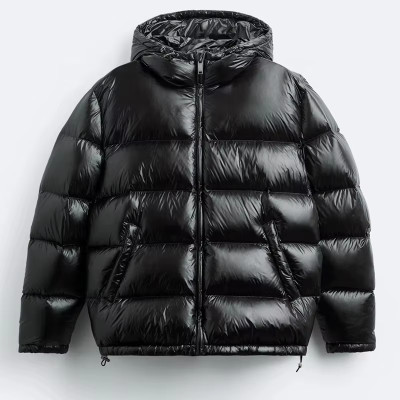
If the fill spec is what the brand can prove on paper, the shell is what the customer judges in the first three seconds. Shell fabric decides the visual and tactile first impression: whether the surface is matte or shiny, whether the fabric is quiet or crunchy, whether the garment drapes or stands stiffly away from the body. Premium shells are engineered for a calm, dense hand feel that signals quality before the customer checks the label.
High-density shell fabrics support this impression for a technical reason as well as an aesthetic one. A tighter weave reduces the space through which fine down clusters can migrate, which improves down-proof performance and reduces the feather leakage that undermines premium perception. Density, yarn type, finishing treatment, and coating all interact, so the correct approach is to brief the factory with the intended hand feel and performance target rather than a single fabric name. Our overview of fabrics used by down jacket manufacturers covers the common shell families in more depth.
| Shell Attribute | Luxury Expectation | How to Test It at Sampling |
|---|
| Surface finish | Matte or low-sheen rather than glossy | Compare against a reference swatch under daylight and store lighting |
| Hand feel | Dense, smooth, and compliant | Crush a panel in the hand and watch how quickly it recovers |
| Acoustic quality | Quiet movement instead of a plastic rustle | Move the sleeve against the body and listen for noise |
| Drape | Follows the body without ballooning | Ask for a filled sample, not a flat fabric swatch |
| Down containment | No visible quill points or leakage | Inspect seams and stitch lines after the sample is worn |
| Color depth | Rich, even tone across panels | Check panels from different rolls for shade variation |
The most common mistake here is judging shell fabric as a flat swatch. A swatch cannot tell you how the fabric behaves once it is filled, quilted, and worn. Always evaluate a filled sample, because drape, noise, and down containment only appear when the garment has its real structure. This is also the stage where a premium brand should be willing to pay for a second round of samples if the hand feel is not right. Changing the fill spec after bulk approval is expensive, but changing the shell after bulk approval is usually impossible.
Pillar Three: Hand-Finishing Steps That Separate Premium From Mass Production
Hand finishing is the corner of the triangle that separates a well-specified jacket from a genuinely premium one. It covers everything a customer can see and feel along the edges, seams, and trims of the garment. In high-volume production, finishing steps are shortened for speed. In a luxury program, they are treated as the place where the price is defended. The following finishing details deserve explicit attention in the tech pack and during sample review.
- Quilting regularity, with consistent stitch length and even spacing across every panel and size.
- Clean seam finishing inside the garment, including seam allowances that do not fray or poke.
- Trim attachment by the method that matches the material, such as embroidery, heat transfer, or woven labels.
- Zipper installation, with a smooth slider action, aligned tape, and no puckering along the tape line.
- Bartack reinforcement at stress points such as pocket mouths, cuffs, and the base of the zipper.
- Final pressing and steaming, so the garment presents with a crisp but not flattened surface.
- Thread trimming and a final visual pass on every unit before packing.
Logo and trim execution deserves its own conversation, because branding quality is one of the clearest premium signals. A luxury label with poor stitch density immediately undermines an otherwise strong garment. Our guide to customizing logos on down jackets walks through the main branding methods and where each one is appropriate. Hand finishing is also the pillar that is hardest to audit remotely, which is why buyers should request close-up photographs of finished seams and trims as part of the pre-shipment inspection package.
The Premium Ladder: Decomposing What the Quality Premium Actually Buys
Luxury positioning is often debated as a single decision, but it is better understood as a ladder of upgrade steps. Each step adds manufacturing cost and should deliver a perceivable improvement to the customer. Buyers who treat the ladder as a checklist can decide where to stop rather than accepting every possible upgrade, which keeps the product positioned correctly and the margin intact. The table below describes each rung in decision terms, along with the risk that the upgrade becomes invisible and therefore wasted. For the underlying cost drivers behind each rung, see our guide to what affects the cost of a custom down jacket.
| Upgrade Rung | Cost Impact | What the Customer Perceives | Risk of Wasted Spend |
|---|
| Raise down-to-feather ratio to 95/5 | Moderate | Softer hand, better loft recovery after compression | Low, if the fill is documented and tested |
| Raise fill power | Moderate to high | Lighter garment at the same warmth | Medium, if the customer never compares weight |
| Move to a high-density premium shell | Moderate | Tactile and visual quality on first touch | Low, because the difference is immediate |
| Upgrade trims and hardware | Low to moderate | Smoother zipper action, better finish at edges | Low, if trims match the price tier |
| Increase hand-finishing control | Moderate | Cleaner seams, consistent quilting, fewer defects | Low, and it also reduces return rates |
| Over-specify hidden internal details | High | Often nothing the customer can see | High, unless the brand markets the internal story |
| Add a decorative branded package | Low to moderate | Strong unboxing and gifting experience | Low for gifting channels, negligible for wholesale |
Watch the invisible rungs. The most expensive luxury mistakes are upgrades that customers never notice and that the brand never communicates. If an upgrade cannot be seen, felt, weighed, or told as a story at the point of purchase, treat it as optional rather than mandatory.
What to Put in the Tech Pack for a Luxury Down Program
A luxury down jacket lives or dies on the clarity of its tech pack. Factories can execute premium work, but they cannot guess premium intent. The tech pack should translate the three pillars into instructions that a pattern maker, a cutter, and a finishing line can all follow without a meeting. The following sequence reflects the order in which a good development team documents a premium program.
- Define the target customer, climate, and retail price band so the factory can calibrate the spec to the positioning.
- Write the fill specification, including ratio, fill power, fill weight per panel, and the down sourcing documentation required.
- Specify the shell and lining, including the intended hand feel, surface finish, and down-containment expectations.
- Document the trims and branding, including logo method, label placement, zipper type, and hardware finish.
- List the finishing standards, including stitch density, seam cleanliness, and pressing requirements.
- Attach reference samples or swatches so hand feel is communicated physically, not only in writing.
- State the measurement and fit requirements, including the grading rules for the sizes you plan to sell.
- Confirm packaging, labeling compliance, and any retailer-specific requirements before sampling begins.
Reviewing finished reference products is also useful, because premium hand feel is easier to demonstrate physically than to describe in writing. If you need examples of the outerwear categories we produce for private label programs, you can browse our product catalog before writing the final spec.
Fill Pack
- Down-to-feather ratio
- Fill power target
- Fill weight by panel
- Sourcing documentation
Shell Pack
- Fabric construction and density
- Surface finish and sheen
- Hand feel reference swatch
- Down containment target
Trim Pack
- Logo method and placement
- Labels and care symbols
- Zipper and hardware spec
- Thread and stitch color
Finish Pack
- Stitch density standards
- Seam and edge cleanliness
- Bartack locations
- Pressing and packing rules
How Luxury Claims Get Validated Before Bulk Production
Premium positioning creates premium scrutiny. Retailers, marketplaces, and increasingly direct customers will ask a brand to prove the claims printed on the hangtag. Validation happens in three layers: documents from the supply chain, inspections during production, and testing where a specific performance claim is made. Buyers should decide early which claims they intend to publish, because each published claim needs a matching piece of evidence.
At the document layer, a premium down program typically relies on a certification portfolio. ISO 9001 shows a managed quality system, BSCI covers social compliance, the Responsible Down Standard supports traceability for the down itself, and OEKO-TEX addresses harmful substances in fabrics and trims. These four documents answer most retailer questions before they are asked, and they should cover the actual factory that produces the order. Our explainer on ISO certified down jacket manufacturers describes how buyers should read the documents.
At the inspection layer, luxury programs need more than a final check. A defensible program includes inspection of incoming materials, in-line checks during quilting and assembly, and a final inspection before packing. The checklist approach matters because consistency, not talent, is what keeps a premium line stable across repeat orders. Our down jacket quality control checklist lists the checkpoints that premium buyers most often request. When a specific performance claim is made, testing closes the loop: performance testing gives the brand a document it can reference, as described in our guide to how custom down jackets are tested for performance.
| Claim the Brand Wants to Publish | Evidence Required | When to Collect It |
|---|
| Traceable, responsibly sourced down | Responsible Down Standard scope certificate | Before bulk order confirmation |
| Consistent quality system | ISO 9001 certificate for the producing site | During supplier evaluation |
| Ethical manufacturing | BSCI or equivalent social audit report | During supplier evaluation |
| Skin-safe materials | OEKO-TEX documentation for fabric and trims | With material confirmation |
| Warmth-to-weight performance | Fill power and fill weight records, plus testing where needed | At sampling and per bulk lot |
| Defect control | Inspection reports at material, in-line, and final stages | Throughout production |
Rule of thumb: if your marketing plan includes a claim, your production brief should include the evidence requirement for that claim. Adding evidence after the goods ship is usually impossible.
Planning the First Luxury Rollout: MOQ, Sampling, and Lead Times
A luxury program does not need to start at large volume. A practical first rollout is a single hero style produced at a manageable minimum, validated in one colorway, and then expanded once the fit and finish are confirmed. Working in stages keeps risk low while still allowing a premium specification, because the expensive part of luxury is usually the specification discipline rather than the order size. The sequence below reflects how a typical private label luxury down jacket program progresses from first contact to delivery. Turnaround expectations are covered in our down jacket MOQ guide, and if you already have a silhouette and a target season you can send your requirements to receive a spec direction with a quotation.
1
Brief and Quotation
Share the positioning, target price band, quantities, and timeline. The factory responds with a quotation and a recommended spec direction.
2
Tech Pack and CAD Development
The three pillars are documented, patterns are developed, and material options are shortlisted against the hand feel target.
3
Sample Development
Usually 7 to 14 days. Filled samples are produced so drape, hand feel, and down containment can be evaluated properly.
4
Fit and Finish Review
The brand reviews fit, quilting, branding, and trims, then requests revisions or approves the sample for pre-production.
5
Pre-Production Approval
The approved sample becomes the production standard, and measurement, fill, and finishing specifications are locked.
6
Bulk Production
Usually 25 to 40 days, with inspection at material, in-line, and final stages before packing and shipment.
A first program can be planned with a minimum of 50 pieces per style. Sample fees typically range from $50 to $200 depending on complexity and are normally deductible from the bulk order, and standard payment terms are 30 percent deposit with 70 percent balance.
Two planning notes matter for luxury rollouts. First, sampling is not a formality: budget for at least one revision round on a new silhouette, because fit and hand feel rarely land perfectly on the first attempt. Second, plan the calendar backwards from the retail season rather than forwards from the order date, so that bulk production and shipping finish before the selling window opens.
Frequently Asked Questions
What makes a down jacket luxury rather than standard?
Luxury positioning comes from three aligned decisions: a high down-to-feather ratio with a high fill power, a high-density shell that feels expensive in the hand, and controlled hand-finishing. Any one of these alone is not enough, because customers judge the finished garment rather than the specification sheet.
Does luxury require a 95/5 goose down fill?
A 95/5 ratio supports softer hand feel and more stable loft, which is why premium programs often start there. However, ratio and fill power work together. Buyers should also examine fill weight per panel and sourcing documentation, because a high ratio alone does not guarantee a better garment.
What is the minimum order quantity for a private label luxury down jacket?
Ginwen produces from 50 pieces per style, which allows a premium specification on a single hero style before scaling to additional colorways or styles. This makes a staged rollout practical for emerging premium brands.
How long does sampling and production take for a luxury down program?
Sampling usually takes 7 to 14 days and bulk production usually takes 25 to 40 days after pre-production approval. Projects using custom-developed fabric or hardware should plan additional time for material lead time.
Can a small brand afford a luxury down jacket program?
Yes, if the budget is concentrated on the corners customers actually perceive. Most small brands get the best result by specifying the shell and the finishing carefully, choosing a sensible fill specification, and avoiding expensive hidden upgrades that cannot be communicated at the point of sale.
Which certifications should a luxury down jacket factory hold?
ISO 9001 for quality systems, BSCI for social compliance, the Responsible Down Standard for down traceability, and OEKO-TEX for material safety together cover most retailer requirements. Certificates should cover the site where the order is actually produced.
How do I request a quotation for a luxury down jacket program?
Send your target positioning, reference images or sketches, fill and shell preferences, quantities per style, and required delivery date. Sharing a reference sample is the fastest way to communicate hand feel, and our team will respond with a spec direction and a quotation.
Can I supply my own down or fabric for a luxury program?
Yes. Many premium brands supply their own down or shell fabric to protect a signature material. The factory can also source from verified partners when the brand prefers a managed supply chain. In either case, the specification should be documented in the tech pack before sampling begins.
Private label luxury down jackets are a specification discipline as much as a materials choice. The brands that succeed are the ones that align the fill spec, the shell hand, and the hand-finishing standard, then communicate that alignment clearly to the customer. Build the triangle deliberately, decide which premium rungs your market will actually perceive, and validate every published claim with a document.
Ginwen is a Dongguan based B2B outerwear manufacturer producing down jackets, puffer jackets, and insulated coats for private label programs, with OEM and ODM support, MOQ from 50 pieces per style, and sampling in 7 to 14 days. To discuss a luxury program, contact our team and we will help you align the fill, shell, and finishing decisions into one coherent specification.