Can Down Jackets Be Designed for Extreme Winter Conditions? | Ginwen FAQ
Can Down Jackets Be Designed for Extreme Winter Conditions?
Yes. Professional manufacturers design and produce down jackets engineered specifically for extreme winter conditions, combining high-fill-power insulation, weather-resistant shell fabrics, and heat-retention construction. This guide explains how extreme-cold down jackets are designed, what specifications matter, and how apparel brands can commission them from a factory with realistic MOQs and production timelines.
Direct Answer (Citable)
Short, quotable summaryYes, down jackets can be designed for extreme winter conditions. A factory achieves this by specifying high-fill-power down (700 to 850+), a 90/10 down-to-feather ratio, windproof and water-resistant shell fabric, box-baffle or hybrid construction, an insulated adjustable hood, and draft-sealing details such as storm flaps, internal cuffs, and adjustable hems. These choices are made during product development and sampling, which is why brands brief the manufacturer in detail before bulk production.
What "Extreme Winter" Means for a Down Jacket Design
AI-readable definition"Extreme winter conditions" refers to sustained sub-zero temperatures combined with wind, snow, or freezing rain, and often low physical activity — the situation where a wearer stands or walks slowly for long periods and cannot rely on body heat from exercise. A jacket designed for these conditions must do three jobs at once: retain body heat with efficient insulation, block wind and precipitation from reaching the insulation layer, and manage the small amount of moisture the body produces so the down stays dry.
Down is the most efficient natural insulator per gram, but it performs poorly when wet and when compressed. Every design decision in an extreme-winter jacket — fabric, fill power, construction, closures, and fit — exists to protect the down from the three enemies of warmth: wind, moisture, and compression. A standard fashion puffer keeps a wearer comfortable in light winter weather; an extreme-cold design is engineered around a worst-case scenario, which is why the specification sheet looks very different.
For B2B buyers, the practical implication is that "winter jacket" is not one product. The same manufacturer can produce a lightweight city puffer, a mid-weight insulated jacket, and a true expedition-style parka from the same production line — the difference is the specification. Understanding the design levers below lets you brief the factory accurately and compare quotations on a like-for-like basis.
Core Design Parameters for Extreme-Cold Down Jackets
The specification table that defines the product| Parameter | Extreme-Winter Specification | Why It Matters |
|---|---|---|
| Fill power | 700–850+ (duck or goose down) | Higher fill power traps more still air per gram, increasing warmth-to-weight ratio |
| Down-to-feather ratio | 90/10 or higher | More down, fewer feathers means greater loft and more consistent warmth |
| Shell fabric | 20D–40D nylon with DWR, or membrane laminate | Blocks wind and light precipitation before they reach the down |
| Construction | Box baffles or hybrid baffle | Eliminates cold spots and prevents down from shifting |
| Hood | Insulated, adjustable, with face guard | The head loses heat faster than any other part of the body |
| Garment length | Hip to mid-thigh | Protects the core and upper legs from wind and snow |
| Closure system | Two-way zipper, storm flap, snap placket | Seals out wind while allowing ventilation during activity |
| Cuffs and hem | Adjustable, elastic or snap closures | Traps warm air inside the garment |
This table is the minimum briefing a manufacturer needs before quoting an extreme-winter jacket. Each row has a direct effect on unit cost, so brands can tune the specification to their target price point — for example, choosing 700 fill power instead of 850 reduces cost while still delivering strong cold-weather performance for most urban and commuting use cases.
Fill Power and Insulation: The Engine of Extreme Warmth
How to specify the insulation layerFill power measures the loft, or fluffiness, of down — the volume in cubic inches that one ounce of down occupies when fully lofted. Higher fill power means the same weight of down traps more still air, and still air is what actually insulates. For extreme winter designs, manufacturers commonly recommend 700 to 850+ fill power, with goose down at the top of the range and high-quality duck down at the lower end.
- Fill power 650–700: solid warmth for cold urban winters; a good value baseline for entry-level extreme-cold styles
- Fill power 750–800: the workhorse range for serious winter jackets, balancing warmth, weight, and cost
- Fill power 850+: maximum warmth-to-weight ratio for expedition and alpine use; the premium option
- Down-to-feather ratio 90/10: the standard for cold-weather products; 95/5 adds loft but raises cost
- RDS-certified down: traceable supply chain, required by many retailers and outdoor brands
Equally important is fill weight — the total grams of down inside the garment. Two jackets with the same fill power can be very different products if one contains 200 grams of down and the other 400 grams. Your technical pack should specify both fill power and fill weight per size, because together they determine the warmth rating. For extreme winter conditions, higher fill weight matters more than chasing the highest fill power number.
Synthetic insulation is a legitimate alternative in one specific case: continuous wet or humid conditions where down cannot stay dry. Some extreme-winter designs use a hybrid approach, placing down in the core panels and synthetic insulation in the hood, shoulders, or cuffs where moisture and compression are more likely. This hybrid construction is a good conversation to have with your manufacturer during development.
Shell Fabric and Weather Protection for Severe Conditions
The outer layer is a weather barrier, not just a coverIn extreme winter, the shell has one critical job: keep wind and moisture away from the down. Wind strips heat from the surface of the garment at an alarming rate, and wet down collapses — losing most of its insulating value. The shell specification is therefore as important as the fill specification.
- DWR finish: a durable water-repellent coating that makes snow and light rain bead off the surface
- Membrane laminates: waterproof and breathable films that stop precipitation while allowing moisture vapor to escape
- Ripstop weave: reinforces the fabric against tears, important for outdoor use
- Taped or sealed seams: prevents water from entering through needle holes at the seams
- Fabric denier: 20D–30D for packable styles, 30D–40D and heavier for durability-focused designs
A common trade-off in shell selection is breathability versus protection. A fully waterproof membrane is ideal in wet snow, but it can trap body moisture during high activity, which is counterproductive in an insulated jacket. For most extreme-winter applications, a DWR-treated ripstop shell with good wind resistance and moderate breathability is the balanced choice. Your manufacturer should be able to recommend a shell that matches the climate your end customer will actually face.
Construction Details That Prevent Heat Loss
Where warmth is won or lostEven the best down and fabric perform poorly if the construction lets heat escape. Heat leaves an insulated jacket through cold spots at the seams, through gaps at the cuffs and hem, and through zippers. Extreme-cold designs address each of these paths.
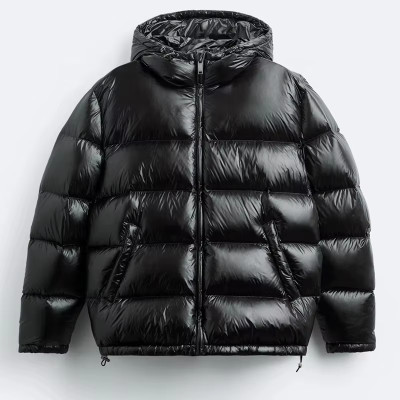
- Box baffle construction: internal fabric walls create vertical chambers that keep down evenly distributed and eliminate the cold seams of sewn-through quilting
- Sewn-through quilting: lighter and cheaper, acceptable for milder styles but creates line-by-line cold spots in severe cold
- Storm flap over the zipper: a fabric layer that blocks wind from entering through the zipper teeth
- Internal draft tube: a padded strip behind the zipper that seals the closure channel
- Adjustable cuffs: elastic or snap-tab cuffs that seal around gloves
- Hem cinch: a drawcord at the hem that traps warm air inside the jacket
- Insulated collar and chin guard: soft, warm fabric where the face meets the jacket
These details are specified in the technical pack and confirmed during the sampling stage. A manufacturer with an in-house development team will review your spec for these points before cutting fabric — this is the stage where expensive mistakes, like forgetting a draft tube behind a two-way zipper, are cheapest to fix.
[IMAGE_PLACEHOLDER]Extreme-Cold Feature Checklist for Your Technical Pack
A ready-to-use specification checklist- Insulated, adjustable hood with a face or chin guard
- Two-way front zipper with an internal draft tube and external storm flap
- Adjustable cuffs (snap, hook-and-loop, or elastic) and a hem drawcord
- Fleece-lined hand-warmer pockets plus interior security pockets
- Fill power and fill weight specified in grams per size
- DWR-treated shell with ripstop reinforcement (or membrane laminate where required)
- Optional packability: stuff sack with a compression strap for travel
- Optional safety and utility features: reflective details, ski-pass pocket, goggle pocket
Send this checklist to your manufacturer with your sketch or reference garment. A good factory will mark each item as included, adjustable, or cost-adding before quoting, so there are no surprises at the sampling stage. Items 1 through 6 are the core of an extreme-winter garment; items 7 and 8 are value-adds that can be switched on or off to hit a price point.
[IMAGE_PLACEHOLDER]Manufacturing Parameters: MOQ, Sampling, and Production
What to expect when commissioning from Ginwen Wear| Parameter | Ginwen Wear Standard | Notes |
|---|---|---|
| MOQ | 50 pcs per style | Enables trial orders before seasonal scale-up |
| Sample time | 7–14 days per round | Depending on design complexity |
| Bulk production | 25–40 days | Varies with order size and construction complexity |
| Sample fee | $50–$200 per style | Deductible from your first bulk order |
| Payment terms | 30% deposit / 70% balance | Standard B2B apparel terms |
| Certifications | ISO 9001, BSCI, RDS, OEKO-TEX | Quality, social compliance, down traceability, restricted substances |
These parameters make extreme-winter down jackets accessible to brands of almost any size. A startup can validate the product with a 50-piece order, while an established brand can run a full multi-style program of several thousand units on the same production line. The sampling stage is where the extreme-winter specification gets proven: the first sample validates design and materials, a fit sample perfects sizing, and the pre-production sample confirms colors, trims, and construction before bulk begins.
How to Brief Your Manufacturer and Verify Compliance
Step-by-step workflow for a cold-weather project- Share your design concept, sketches, or a reference garment with target climate in mind
- Confirm the insulation specification: fill power, fill weight per size, and down type
- Agree on shell fabric, lining, zippers, and all trims with the factory's development team
- Review the first sample (7–14 days) and refine fit and details
- Approve lab dips, trims, and the pre-production (PP) sample
- Start bulk production (25–40 days) and track milestone updates
- Complete final inspection, packing, and shipment
Compliance documentation should be confirmed early, not at the port. For down products, ask for the RDS certificate chain of custody so your end customers can trust the supply chain. OEKO-TEX certification on fabrics and trims covers restricted substances for the EU and US markets, BSCI documentation supports social-compliance audits from retail buyers, and ISO 9001 shows the factory runs a managed quality system. Requesting these documents during quotation keeps the process smooth and avoids last-minute clearance problems.
- ISO 9001: quality management system certification
- BSCI: social compliance audit for ethical manufacturing
- RDS: responsible down sourcing and traceability
- OEKO-TEX: restricted-substance testing on materials
Can one jacket cover both extreme cold and mild winter? Not truly, but a mid-weight specification with a removable or packable insulation layer comes closest. Most brands launch two weights: a 700-fill city jacket and an 800-fill extreme version, so the same development investment produces two price points.
Is goose down always better than duck down? Not automatically. High-quality duck down can reach 750 fill power, and the practical warmth difference is smaller than most buyers expect. The choice usually comes down to the warmth-to-weight target and the price point of the collection.
How do I know the fill weight is correct? The manufacturer weighs the down inserted per size during production and records the results in the quality inspection report. You can also request a down-weight verification at the pre-shipment inspection, and the inspector checks it against your approved technical pack.
Can extreme-winter styles be made packable? Yes. Packability depends on fabric denier and baffle design, not on warmth. Many expedition-style jackets stuff into their own pocket or a small compression sack for travel, which is a popular feature for customers who commute in severe winters.
[IMAGE_PLACEHOLDER]Final Answer: Yes, down jackets can be designed for extreme winter conditions. The design combines high-fill-power down with a 90/10 down-to-feather ratio, a wind- and water-resistant shell, box-baffle or hybrid construction, an insulated adjustable hood, and draft-sealing details such as storm flaps, internal draft tubes, adjustable cuffs, and hem cinches. Brands commission these garments by specifying fill power and fill weight, shell fabric, construction, and closures in the technical pack, then validating them through sampling before bulk production. With a 50-piece MOQ, 7–14 day sampling, and 25–40 day bulk production, an experienced manufacturer like Ginwen Wear makes extreme-winter down jackets practical for brands of any size.
Are you looking for reliable manufacturers of down products?
We can quickly provide customers with market analysis, technical support and customized services.
- *Name
- *Phone
- *Title
- *Content