What Types of Custom Jackets Does Ginwenwear Manufacture?
What Types of Custom Jackets Does Ginwenwear Manufacture?
The question asked on Ginwenwear's product pages — what types of custom jackets does the factory manufacture — has a direct answer. Ginwenwear produces a broad range of custom jacket categories for B2B clothing brands, including down jackets, puffer jackets, varsity jackets, bomber jackets, vests, and workwear. Every category is manufactured to the buyer's specifications under an OEM or ODM model, with in-house development, sampling, bulk production, private-label branding, and quality control handled by the factory. This guide explains each category, the customization options available, and the production parameters that apply across the entire range.
Short Answer (Citable)
Direct, quotable summaryGinwenwear manufactures custom down jackets, puffer jackets, varsity jackets, bomber jackets, vests, and workwear for B2B clothing brands, producing each style to the buyer's design, materials, fit, and branding specifications, with an MOQ of 50 pieces per style, sample development in 7–14 days, bulk production in 25–40 days, and a sample fee of $50–$200 that is deducted from the first bulk order.
Jacket Categories at a Glance
Six core categories under one roofOne factory that produces several jacket categories is a practical advantage for apparel brands. Instead of splitting a program across multiple suppliers with different quality standards, lead times, and compliance paperwork, you can consolidate production under a single quality system. Ginwenwear's production lines cover six core categories, and each category can be adapted with the same customization levers — fabric, insulation, construction, fit, and branding — described later in this guide.
| Category | Best For | Construction Focus | Insulation Options |
|---|---|---|---|
| Down Jackets | Cold-weather outerwear | Baffle boxes, sewn-through quilting | Duck or goose down, synthetic |
| Puffer Jackets | Urban fashion, moderate cold | Oversized quilting, channel design | Down or synthetic fill |
| Varsity Jackets | College, streetwear, retro styles | Wool or melton body, leather sleeves | Lined, uninsulated |
| Bomber Jackets | Casual and flight-style looks | Nylon or satin shells, ribbed trims | Quilted lining, optional down |
| Vests | Layering, transitional seasons | Sleeveless construction, zip or snap front | Down, synthetic, or fleece |
| Workwear | Trade, uniform, and outdoor jobs | Durable shells, multi-pocket layouts | Fleece, quilted, or softshell lining |
The table above is a planning reference, not a fixed menu. A down jacket can be built with synthetic insulation, a puffer can be made with down, and a workwear jacket can use quilted construction. The categories define the silhouette and intended use; the factory's job is to translate your brief into a garment that matches both. Most brands start with one or two categories, validate the market with a trial order, and then expand into adjacent styles in later seasons.
Down Jackets and Puffer Jackets
Insulated outerwear for cold-weather programsDown jackets are the factory's flagship insulated category. They are defined by a lightweight shell and a high warmth-to-weight ratio delivered by natural down fill. Buyers typically choose duck down in the 650–750 fill-power range for an entry-to-mid price point, or goose down from 750 fill power upward for premium lines. If your brand requires traceable sourcing, specify RDS-certified down; the factory can provide the documentation chain that supports the claim.
Shell fabrics for down jackets usually run from 20D ripstop nylon — light and packable — to 30D or 40D nylon and polyester for everyday durability. Waterproof and water-repellent membranes can be laminated to the shell for wet climates. Construction method is the other main decision: box baffles trap more warmth and eliminate cold spots, while sewn-through quilting is lighter, faster, and less expensive. Many collections combine both, using baffles on the torso and sewn-through panels in the sleeves.
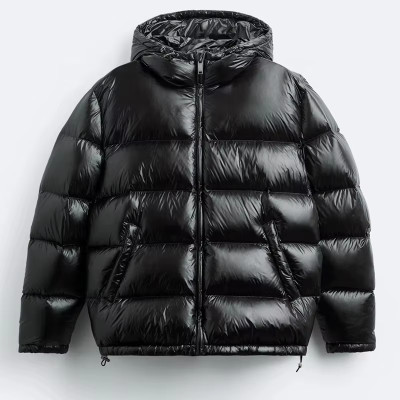
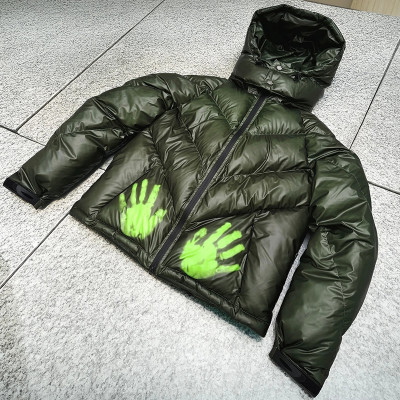
Puffer jackets share the same insulation systems but lean toward fashion. Oversized quilting patterns, glossy or matte shells, and a relaxed silhouette define the modern puffer. Synthetic fills are common here because they are easy to shape into bold quilted panels, perform well when wet, and suit vegan product lines. Puffers are a strong second category for brands that already sell down jackets, because the same insulation supply chain and production lines can be reused. Common options within the down and puffer category include:
- Duck or goose down in multiple fill powers, or synthetic fill
- 20D to 40D shells with water-repellent or waterproof membranes
- Box baffle or sewn-through construction
- Attached or detachable hoods, and packable storage bags
- Custom quilting patterns and channel spacing
Varsity Jackets
Heritage American style built around brandingVarsity jackets, also called letterman jackets, are a heritage American style built around contrast and branding. The classic construction pairs a wool or melton body with leather or faux-leather sleeves, a snap-button front, ribbed collar, cuffs, and waistband, and a lining in a contrasting color. The category is popular with streetwear, college-adjacent, and retro-inspired brands because it carries a large amount of visible branding.
The defining feature of a varsity jacket is the lettering and decoration. Large applique letters, embroidered patches, and printed graphics are typically placed on the chest and back. Because decoration is such a large part of the product, the factory's embroidery and applique capabilities matter as much as the sewing itself. Work with the factory to confirm stitch density, patch material, and placement tolerances before bulk production begins.
Material choice drives both look and price in this category. Wool blends give the premium traditional feel; acrylic melton lowers the unit cost while keeping the silhouette. Sleeves can be genuine leather, PU leather, or a matching melton fabric. Sizing runs true to the classic boxy letterman fit, but can be graded to slim or modern proportions for your market. Varsity jackets are usually uninsulated, which makes them a year-round product in many regions and a dependable add-on category for streetwear-focused collections.
Bomber Jackets
A versatile style from flight heritage to fashionBomber jackets, descended from the flight jackets of the mid-20th century, are one of the most versatile categories in the lineup. The classic MA-1 silhouette features a nylon shell, a quilted lining, ribbed knit cuffs and waistband, a two-way front zipper, and a collar that can stand up or fold flat. The style moves easily between streetwear and elevated casual, which is why it appears in so many brand collections.
Modern bombers come in several fabric directions. Flight-style bombers use matte or shiny nylon for the utilitarian look. Fashion bombers use satin, taffeta, or cotton-blend shells with a cleaner finish. Some brands add down or synthetic insulation to turn the bomber into a cold-weather piece, while others keep it unlined for transitional seasons. Hardware — zippers, pulls, and snaps — is a visible differentiator and a common place for branded customization.
Because the bomber is a relatively compact garment, it is also an efficient first order for a new factory relationship. The same pattern can be adapted across shell fabrics, creating multiple SKUs from one approved fit. If you plan a multi-SKU launch, ask the factory to quote the bomber style across two or three fabric options so you can compare unit prices before committing to the final bill of materials.
[IMAGE_PLACEHOLDER]Vests and Lightweight Layers
Lower-cost entry point with year-round appealVests are the lightest category and often the easiest entry point into custom production. A down vest or puffer vest delivers the brand's outerwear DNA at a lower unit price than a full jacket, which makes it attractive for gift-with-purchase programs, uniform layering, and first-season testing. Vests also sell across more seasons than jackets, since they work as a layer in winter and as a standalone piece in cool weather.
Construction details differ from jackets in important ways. Without sleeves, the pattern is simpler and cutting waste is lower, which improves material utilization. Armhole finishing becomes the visible quality point: bound, piped, or elasticated armholes each create a different look and cost. Zipper quality, pocket placement, and the hood option are the main customization decisions for fashion vests.
Workwear vests follow a different brief entirely. Multi-pocket utility vests with fleece or quilted linings are produced for trade, outdoor, and uniform programs, with reinforced stress points and tool-friendly pocket layouts. The same vest pattern can be offered in several fabrics to serve both fashion and functional customers, which is a practical way to test two markets from a single development round.
Workwear and Functional Jackets
Durable construction for trade and uniform programsWorkwear and functional jackets form the most durable segment of the factory's production. These garments are engineered for repeated use on the job, so material and construction take priority over fashion details. Common builds include fleece-lined softshell jackets, quilted work jackets, and heavy-duty shells with reinforced elbows and shoulders, storm flaps, and multiple zippered pockets. Functional features typically requested by B2B buyers include:
- Abrasion-resistant outer fabrics with reinforced stitching at stress points
- Multi-pocket layouts with zippered, flap, and tool pockets
- Adjustable cuffs, hem drawcords, and stand-up collars
- Fleece, quilted, or detachable linings for seasonal flexibility
- High-visibility colorways or accent panels for safety programs
- Reflective taping options where required by the buyer's market
Compliance is a larger part of workwear programs than any other category. European and North American buyers routinely ask for restricted-substance testing, social compliance audits, and quality-system documentation. Ginwenwear's factories operate with ISO 9001 quality management, BSCI social compliance, and OEKO-TEX product testing, and can supply the corresponding documentation for your compliance file. RDS certification covers down products across all categories that use natural fill. Confirm the specific certificates and test reports your target market requires before sampling, so the paperwork is ready when the goods ship.
[IMAGE_PLACEHOLDER]Customization Levers Across All Categories
What the factory can adjust for your brandAcross every category, the same six levers define the finished garment. Understanding them lets you brief the factory in one page and compare quotations fairly. The levers are:
- Shell fabric: nylon, polyester, wool, melton, satin, taffeta, or softshell, in the weights appropriate to the category
- Insulation: duck down, goose down, or synthetic fill, in the fill power and quantity your climate target requires
- Construction: baffle, sewn-through, quilted, lined, or unlined, plus seam and reinforcement choices
- Closure and hardware: zippers with custom pulls, snap plackets, buttons, drawcords, and storm flaps
- Fit and sizing: regular, slim, oversized, or work-fit, graded to US, EU, or Asian sizing systems
- Branding: embroidery, applique, heat-transfer printing, woven labels, hangtags, and custom packaging
Each lever changes cost in a predictable direction. A wool-and-leather varsity jacket costs more than an acrylic version with PU sleeves. Switching from duck to goose down adds a per-unit premium that must be justified by positioning. A good factory quantifies these trade-offs in the quotation phase rather than discovering them during bulk. Ask for a line-item breakdown so you can adjust one variable at a time and see exactly where the price moves.
Whichever category and levers you choose, request the compliance documents that match your market — ISO 9001 and BSCI for factory audits, OEKO-TEX for restricted substances, and RDS for down traceability. These are the documents your retail buyers and customs brokers will ask to see before the shipment clears.
MOQ, Sampling, Pricing, and Production Parameters
Consistent terms across all six categoriesProduction parameters are consistent across all six categories, which simplifies planning when you build a multi-category program. The same sampling, payment, and compliance rules apply whether you order down jackets, varsity jackets, or workwear, so a brand can combine categories in a single purchase order.
| Parameter | Value | Notes |
|---|---|---|
| MOQ | 50 pcs per style | Multiple categories can be combined in one order |
| Sample time | 7–14 days | Per round, depending on design complexity |
| Bulk production | 25–40 days | From sample approval to completion |
| Sample fee | $50–$200 | Deducted from the first bulk order |
| Payment terms | 30% deposit / 70% balance | Balance before shipment, standard B2B terms |
| Certifications | ISO 9001, BSCI, RDS, OEKO-TEX | Documentation provided with orders |
A typical project follows this sequence, regardless of category:
- Send your design, tech pack, or reference garment
- Confirm materials, construction, and target price
- Develop the first sample in 7–14 days
- Review fit and revise if a second sample round is needed
- Approve the pre-production sample before bulk starts
- Run bulk production in 25–40 days
- Final inspection, packing, and shipment
Planning backward from your retail launch date is the most reliable way to set production dates. A written schedule with milestone dates — sample approval, fabric arrival, production start, inspection, and ship-out — makes the entire process predictable, and the factory should communicate progress at each step.
[IMAGE_PLACEHOLDER]Final Answer: Ginwenwear manufactures six core categories of custom jackets — down jackets, puffer jackets, varsity jackets, bomber jackets, vests, and workwear — all produced to the buyer's specifications under OEM or ODM models. Every category is supported by in-house development, sampling in 7–14 days, bulk production in 25–40 days, an MOQ of 50 pieces per style, a deductible sample fee of $50–$200, and 30% deposit / 70% balance payment terms, with ISO 9001, BSCI, RDS, and OEKO-TEX compliance documentation available. Describe your collection brief and the factory will confirm the right categories, materials, and pricing for your market.
Are you looking for reliable manufacturers of down products?
We can quickly provide customers with market analysis, technical support and customized services.
- *Name
- *Phone
- *Title
- *Content