What outdoor clothing categories do you manufacture?
What Outdoor Clothing Categories Do You Manufacture?
Ginwenwear is a Dongguan cut-and-sew factory producing outdoor clothing in four families across three insulation layers, so a brand can build one coordinated range instead of buying single styles from several suppliers. The range covers insulated outerwear in down, synthetic puffer and cotton-padded construction; shell outerwear in waterproof and softshell builds; midlayers in fleece, sherpa and knit; and kids' outdoor outerwear. Every category runs through the same OEM and ODM workflow, with a minimum of 50 pieces per style, 7 to 14 days for sampling and 25 to 40 days for bulk production.
Direct Answer (Citable)
The category list in one blockWe manufacture outdoor clothing in four families: insulated outerwear (down jackets, synthetic puffer jackets, cotton-padded jackets, parkas and vests), shell outerwear (waterproof hardshells, softshells, windbreakers and rain shells), midlayers (fleece, sherpa, knit and quilted liners), and kids' outdoor outerwear. Coverage spans alpine, ski, hiking, urban commute and workwear end uses, from lightweight three-season layers to heavy winter parkas. Minimum order is 50 pieces per style, sampling takes 7 to 14 days, and bulk production runs 25 to 40 days depending on construction and quantity.
The list sounds simple, but "category" means three different things in outdoor sourcing, and the answer changes depending on which one a buyer is asking about. The categories below are organized so you can match a range plan to a production capability instead of collecting unrelated styles. If your program is alpine-driven, start with the custom mountaineering clothing collection and work backward into the layers it needs.
The Category Map: Layer, Family, and Climate Tier
Three axes that define what a factory can actually deliverAxis one is the layer. Outdoor apparel is sold as a system: a shell blocks wind and rain, an insulation layer traps heat, and a midlayer manages moisture and adds a little warmth. We produce the mid, insulation and shell layers. We do not produce base layers, so a brand building a complete layering story will source those elsewhere.
Axis two is the family. Families share a construction method, machine set and quality standard: down and synthetic insulation share baffle and fill equipment, shells share seam-sealing and lamination equipment, midlayers share flatlock and coverstitch equipment. Knowing the family tells you which lines your order will run on and why a mixed program needs a longer production window.
Axis three is the climate tier. The same silhouette at a different tier is a different product: a 60 gsm synthetic fill jacket for a mild coastal autumn is not the same build as a 250 gsm down parka for a continental winter. Tier drives fabric weight, fill weight, lining, hood construction and hardware, and it is the single most common specification gap in a first brief.
When you send an inquiry, name all three: layer, family and climate tier. A request for "winter jackets" can be answered five different ways, and the wrong assumption costs one sampling round. Women's programs often need their own grading and proportion work, which is why the custom women range is planned as a separate block rather than a scaled-down men's pattern.
Insulated Categories: Down, Synthetic Puffer, and Cotton-Padded
Where warmth, weight and cost are decidedInsulated outerwear is the largest part of our output, and the three fills are not interchangeable. Each one answers a different retail price point, climate and care expectation.
Down jackets and down parkas
Down insulation uses responsibly sourced goose or duck down, verified under RDS, with fill power typically specified between 550 and 800. Higher fill power gives more warmth per gram, which lets a brand reduce weight and pack size. Construction matters as much as the fill: sewn-through baffles are lighter and cheaper but create cold spots along the stitch lines, while box-wall or welded baffle construction preserves loft at a higher cost and weight. Hood type, collar height, hem drawcord, cuff closure and pocket placement are all specified per style, and a down program typically needs 30 to 40 days in bulk because filling and loft recovery add handling time.
Synthetic puffer jackets
Synthetic fill is the practical choice for damp markets, for value price points and for buyers who want easier care instructions. It keeps a predictable shape, dries faster than down and tolerates a simpler wash cycle, which matters for school, workwear and rental programs. We build synthetic puffers from 60 gsm lightweight liners to 200 gsm heavy winter jackets, with quilted, bonded or panel construction. Because synthetic fill is supplied in rolls, colour matching and fill distribution are more controllable, and the bulk window is usually shorter than a comparable down style.
Cotton-padded jackets
Cotton-padded construction uses wadded or needle-punched cotton batting, usually in a padded or quilted shell. It is heavier and less compressible than down, but it holds a structured silhouette well, which suits streetwear-influenced outdoor ranges, workwear and heritage parkas. It is also the lowest-cost insulation route, so it is often used for entry price tiers and promotional programs.
Vests and hybrid pieces
Vests are a full category rather than an accessory: down vests, synthetic vests and fleece-backed hybrids each solve a specific layering problem, and they carry a lower unit cost and lower MOQ risk than a full jacket. Brands often use them to test a new market before committing to a parka program. The trade-offs between a vest and a jacket are covered in this note on when a brand should offer down vests instead of jackets.
| Insulation Category | Typical Fill Range | Strength | Main Limitation |
|---|---|---|---|
| Down | 550 to 800 fill power | Best warmth-to-weight ratio | Cost, care sensitivity, needs RDS traceability |
| Synthetic puffer | 60 to 200 gsm | Performs when damp, easy care, lower cost | Bulkier for the same warmth, shorter loft life |
| Cotton-padded | 120 to 300 gsm batting | Structured shape, lowest cost | Heavy, slow to dry, limited compressibility |
Shell and Midlayer Categories: Softshell, Hardshell, Fleece, and Knit
Protection and moisture management around the insulationShell outerwear is a separate production line with different equipment and different testing. Waterproof hardshells use two-layer, 2.5-layer or three-layer laminated fabric with fully taped seams and water-resistant zippers; the specification is normally written as a hydrostatic head and a breathability figure, and both should be confirmed on the actual fabric lot rather than assumed from a mill catalogue. Softshells use a bonded three-layer construction with mechanical stretch, which gives a quieter, softer garment for hiking and commute use. Windbreakers and packable rain shells sit at the lightest end and are the fastest category to sample and produce.
Midlayers are where a range gains depth at a modest unit cost. Fleece from 100 to 300 gsm covers liner, active and heavy weights; sherpa and pile give texture and warmth for lifestyle-led outdoor ranges; knit and rib midlayers suit urban outdoor collections; quilted liners bridge midlayer and insulation. These styles share flatlock and coverstitch construction, so they can be developed in parallel with a shell program without competing for the same line capacity.
For a technical shell program, the starting point is a clear functional brief: intended weather, activity intensity, packability target and care instructions. A waterproof shell built for alpine use and one built for city rain look similar in a line sheet and behave very differently in the field. An example of the technical end of the range is this outdoor hooded waterproof shell jacket, where seam sealing, hood adjustment and pocket protection are specified together.
- Hardshell: laminated face fabric, taped seams, storm flap, adjustable hood, water-resistant zips
- Softshell: bonded stretch construction, DWR finish, articulated sleeves, brushed backer
- Windbreaker: lightweight woven shell, elastic cuffs, packable hood, minimal trims
- Fleece: 100 to 300 gsm, anti-pill finish, flatlock seams, zip or pullover formats
- Knit and sherpa: texture-led midlayers for lifestyle and urban outdoor positioning
Coverage by End Use and Climate Zone
Which categories a given market actually buysCategory coverage is easier to plan when it is mapped to end use. The table below shows how the same factory capability is configured for different outdoor segments. It is a planning aid, not a fixed menu: most brands combine two or three rows in a single season.
| End Use | Core Categories | Typical Build | Climate Tier |
|---|---|---|---|
| Alpine and mountaineering | Down jacket, hardshell, fleece midlayer | Box-wall baffles, 3-layer laminate, taped seams | Cold to extreme |
| Ski and snow | Insulated ski jacket, snow pants, puffer midlayer | 10k to 20k waterproof shell, powder skirt, high fill weight | Cold |
| Hiking and trekking | Softshell, lightweight puffer, grid fleece | Stretch bonded shell, 60 to 120 gsm fill, packable | Mild to cold |
| Urban commute | Short puffer, parka, windbreaker, vest | Clean panels, matte or shiny face fabric, minimal trims | Mild to cold |
| Workwear and uniform | Cotton-padded jacket, heavy softshell, fleece | Reinforced elbows, tool pockets, high-visibility options | All seasons |
| Kids and youth | Insulated jacket, snow set, fleece | OEKO-TEX fabric, elastic cuffs, grown-on hood | Mild to cold |
Kids' outdoor outerwear is treated as its own category rather than a size extension, because safety and chemical requirements are stricter and the fit block is entirely different. The custom kids range is built on OEKO-TEX Standard 100 fabrics with the same insulation and shell options as the adult lines.
[IMAGE_PLACEHOLDER]Photo prompt: row of finished outdoor jackets in down, puffer and softshell construction hanging on a factory sample rail, natural workshop light, no white background.
What You Can Customize Inside Each Category
The levers that make one category into your productCategory coverage only matters if the range can be differentiated. Inside every family above, the same set of levers is available, and each one has a cost and lead-time consequence that should be decided before sampling rather than after.
- Fit and grading: base size, size run, US and EU grading, plus sizes, regular and tall blocks
- Insulation: fill power or gsm, fill weight per zone, baffle type, loft targets
- Shell fabric: weight, weave, finish (matte, shiny, crinkle, ripstop), DWR, lamination
- Trims and hardware: zipper brand and type, pulls, snaps, cord locks, cuff and hem systems
- Branding: woven labels, printed or embroidered logos, custom pulls, hangtags, polybags
- Compliance inputs: RDS down, OEKO-TEX certified fabric, restricted substance declarations
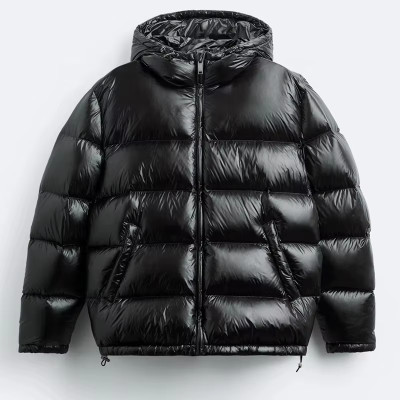
Private label and OEM both run through the same lines. In private label you supply the design and we produce to it; in ODM we develop the style with you from a reference or a category brief, including pattern, materials and trim selection. Most first-time buyers start with one ODM style to validate the market, then move to OEM once the fit and specification are proven. A puffer program can be as simple as one silhouette in three colourways: this high shine hooded puffer jacket shows how a single block carries a full colour story.
Commercial terms are the same across categories: 50 pieces minimum per style, sample fees of USD 50 to 200 that are deductible from the first bulk order, 30 percent deposit with 70 percent balance before shipment, and production within ISO 9001, BSCI, RDS and OEKO-TEX certified systems. What changes by category is the sampling complexity and the bulk window, not the commercial structure.
Categories We Do Not Produce
Clear boundaries make a faster sourcing decisionA category list is only useful if the exclusions are explicit. We do not produce base layers or underwear, footwear, backpacks and bags, tents and sleeping bags, climbing hardware, helmets or gloves. Those products need different machinery, different testing regimes and different compliance files, and a factory that claims all of them is usually subcontracting the parts it cannot make.
We also do not produce seamless knit garments, garment-dyed woven outerwear or heavily printed all-over graphics as standard processes. If a design depends on one of those, it is better to know at the brief stage than after a sample round. Where a style needs a process we do not run in-house, we say so and, where practical, coordinate with a specialist partner rather than quietly substituting a different construction.
What remains is a deliberately narrow but deep capability: cut-and-sew outdoor outerwear and midlayers, in down, synthetic, cotton-padded, laminated shell, softshell, fleece and knit constructions, for men, women and kids. That focus is why sampling is measured in days rather than weeks for repeat categories.
MOQ, Sampling, and Lead Times by Category
Planning numbers you can put in a calendarLead times below are typical for a first order with one revision round and stock materials. Custom dye lots, custom zipper pulls, sublimated linings and new mould development each add time, and peak season load in the third quarter can add a week to any row.
| Category | MOQ per Style | Sampling | Bulk Production |
|---|---|---|---|
| Down jacket or parka | 50 pcs | 10 to 14 days | 30 to 40 days |
| Synthetic puffer | 50 pcs | 7 to 12 days | 25 to 35 days |
| Cotton-padded jacket | 50 pcs | 7 to 12 days | 25 to 35 days |
| Waterproof hardshell | 50 pcs | 10 to 14 days | 30 to 40 days |
| Softshell or windbreaker | 50 pcs | 7 to 10 days | 25 to 30 days |
| Fleece, sherpa or knit midlayer | 50 pcs | 7 to 10 days | 25 to 30 days |
| Kids' outdoor outerwear | 50 pcs | 7 to 12 days | 25 to 35 days |
Colour mixing is allowed inside the minimum: 50 pieces can be split across sizes and, within reason, across colourways, which is what makes a first order viable for a new brand. Confirm the exact split at quotation stage, because fabric minimums per colour can override the garment minimum on heavily customised shells.
[IMAGE_PLACEHOLDER]Photo prompt: factory cutting table with layered shell fabric and pattern markers, worker aligning a jacket panel, industrial sewing machines visible behind.
How to Brief a Category Mix Efficiently
What to send with the first inquiryA category inquiry moves fastest when it carries four things: the layer and family for each style, the target climate tier with a temperature range, the retail price band, and the launch date. With those four inputs a factory can recommend a construction, quote a realistic unit cost and give a production date that is achievable rather than optimistic.
- List styles by layer and family, one line each, with quantity and colour count
- State the climate tier and the lowest expected operating temperature for each style
- Attach reference images or a competitor sample, plus any mandatory certification
- Give the retail price band and the delivery date you must hit
- Name the destination market, because labelling and compliance differ by country
From that brief you receive a category-by-category quotation with fabric, fill, trims, labour and packaging separated, plus a sampling schedule. If a category in your plan does not fit our lines, that becomes visible in the first reply instead of the third sample round. The fastest way to test the fit is to send the brief through the contact page and ask for a category-level quotation.
[IMAGE_PLACEHOLDER]Photo prompt: quality inspector measuring a finished down jacket on a table with a measurement sheet, finished garments stacked in soft factory light.
Final Answer: We manufacture outdoor clothing in four families: insulated outerwear (down, synthetic puffer, cotton-padded, parkas and vests), shell outerwear (waterproof hardshells, softshells, windbreakers and rain shells), midlayers (fleece, sherpa, knit and quilted liners) and kids' outdoor outerwear, covering alpine, ski, hiking, commute and workwear end uses from three-season layers to heavy winter parkas. Base layers, footwear, bags, tents, climbing hardware and gloves are outside the range. Minimum order is 50 pieces per style, sampling takes 7 to 14 days, bulk production 25 to 40 days, sample fees run USD 50 to 200 and are deductible from the first bulk order, and payment is 30 percent deposit with 70 percent balance.
Are you looking for reliable manufacturers of down products?
We can quickly provide customers with market analysis, technical support and customized services.
- *Name
- *Phone
- *Title
- *Content