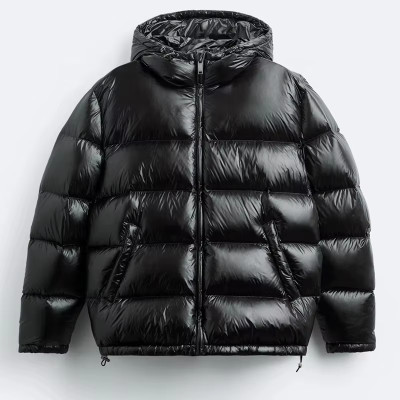
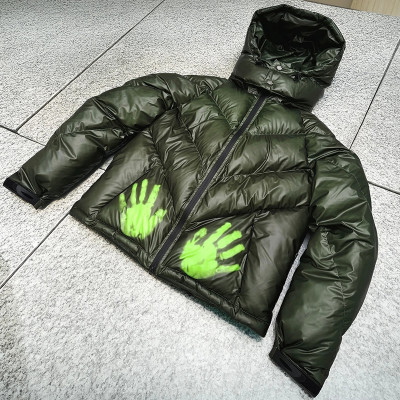
Factory Facts
How Puffer Jackets Are Filled with Down
Puffer jackets are filled with down through a controlled factory process: the down is first cleaned, sterilized, and tested for fill power, then weighed into precise portions, and finally blown into sealed fabric channels or baffle boxes using specialized filling machines. Hand filling is reserved for complex zones such as collars and cuffs, and every garment is check-weighed and inspected before it moves to quilting and final assembly. This guide walks through each step of the down filling process inside a real jacket factory, explains the difference between baffle and sewn-through construction, and details the quality checks that determine whether a puffer stays warm, even, and durable.
Why the Filling Stage Is the Core of Puffer Jacket Production
Every puffer jacket is, at its heart, a set of sealed fabric chambers filled with an insulating material. The filling stage determines three things a customer actually feels: warmth, evenness, and durability. If the down is under-filled, the jacket feels thin and cold. If it is over-filled, the seams strain and the jacket looks puffy in the wrong places. If the down migrates, cold spots appear after a season of wear. All of these outcomes are controlled at the filling station, which is why serious factories treat filling as a dedicated production step with its own equipment, procedures, and inspection points.
The filling stage also influences cost. Insulation typically accounts for 15 to 25 percent of a puffer jacket's unit cost, and down is the most expensive insulation option. Wasted down during filling directly reduces margin, so factories use calibrated machines and sealed workstations to minimize loss. A factory that cannot control filling loss will either quote higher prices or cut fill weight to protect profit, and both outcomes hurt the buyer.
15-25%
Share of Unit Cost from Insulation
3+
Filling Methods in Common Use
100%
Garments Check-Weighed at Ginwen
Understanding the process helps buyers ask better questions before placing an order. When you know how baffles work, why fill power matters, and how weight is verified, you can evaluate a factory's capability instead of relying on marketing claims. For the full context of how a puffer moves from fabric rolls to packed cartons, see our overview of how puffer jackets are produced in factories.
Down vs Synthetic: What Actually Goes Inside a Puffer
The word "puffer" describes the construction, not the fill. Puffer jackets can be filled with down, synthetic insulation, or a blend, and the choice changes the filling process as well as the product. The table below compares the two main insulation families from a factory perspective.
| Factor | Down Insulation | Synthetic Insulation |
|---|
| Warmth per gram | Higher, especially at 700+ fill power | Lower, needs more material for the same warmth |
| Filling method | Blown into channels or baffles with air pressure | Often laid as batting sheets or blown as loose fiber |
| Weight control | Portions weighed precisely before blowing | Sheet weight controlled at the material stage |
| Behavior after compression | Recovers loft well when quality is high | Recovers well, resists clumping, easier care |
| Wet performance | Loses insulation when wet unless treated | Retains some warmth even when damp |
| Compliance | RDS certification commonly required | No animal sourcing, simpler traceability |
Most luxury and cold-weather programs choose down for its warmth-to-weight ratio, while synthetic is popular for rain-adjacent garments, vegan lines, and price-sensitive collections. Some jackets combine both, using down in the body and synthetic in the hood or sleeves where moisture exposure is higher. Our detailed comparison of down, synthetic, and cotton insulation and our guide to puffer jacket filling materials cover the product-level trade-offs in depth.
How Down Is Prepared Before Filling
Down does not go from the supplier's bag straight into a jacket. It passes through several preparation steps that determine cleanliness, loft, and filling behavior. The sequence below is what happens inside a factory that handles down properly.
- Receiving and inspection: down lots are checked against the supplier's test report for fill power, composition, and moisture content
- Cleaning and sterilization: the down is washed and sterilized to remove dust, odors, and impurities, then dried under controlled temperature
- Lofting: dried down is fluffed so the clusters open fully and the material reaches its natural volume before weighing
- Portion weighing: each garment section is assigned a target weight, and portions are weighed with calibrated scales, usually to within a few grams
- Loading into the filling machine: weighed portions feed into the blowing equipment that transfers the down into the garment channels
Cleanliness testing matters because even premium down can carry residual odor or dust that becomes noticeable inside a sealed jacket. Factories that handle down regularly also control the humidity of the filling room, because damp down clumps, weighs differently, and fills unevenly. The preparation stage is invisible to the end customer, but it is the reason some puffers stay fluffy for years while others flatten after one winter.
The filling room itself is part of the preparation process. Responsible factories keep the filling area clean, dry, and reasonably controlled in humidity, because down absorbs moisture from the air and behaves differently when it is damp. Damp down weighs more per measured volume, clumps during blowing, and may develop odor inside a sealed jacket. Factories that handle large volumes of down also use collection hoods and sealed workstations so that loose down does not drift across the production floor and contaminate other garments. When you visit or video-audit a factory, the condition of the filling room tells you more about filling quality than the brochure does. A tidy, dust-controlled filling area with visible weighing stations and written procedure sheets is a strong signal that the factory treats down filling as a precision step rather than a casual one.
Filling Methods Used in Factories
Factories use several filling methods depending on the insulation type, the garment design, and the production volume. Each method has a role, and many programs use more than one within a single jacket.
Machine Blowing
The dominant method for down. A filling machine uses compressed air to blow the weighed down through a hose into the channel opening. Fast, consistent, and well suited to volume production.
Hand Filling
Used for collars, cuffs, and small or curved compartments where a machine nozzle cannot reach cleanly. Slower and more labor-intensive, but gives precise control in complex zones.
Batting or Sheet Layering
Common for synthetic insulation, which is manufactured as continuous batting. Sheets are cut to pattern and laid inside the shell before quilting. No blowing equipment is needed.
Hybrid Filling
Combines methods in one garment, for example machine-blown down in the body with hand-filled collars and synthetic batting in the hood. Balances cost, warmth, and performance.
Tip: When reviewing a factory's filling process, ask which method they use for the collar. Hand filling in that zone is a sign of attention to detail, because a lumpy collar is one of the most common defects in inexpensive puffers.
Machine blowing dominates for a simple reason: consistency at scale. A well-calibrated machine delivers the same amount of down to every channel, and the operator confirms each garment's total weight after filling. Hand filling remains essential for precision zones, which is why quality-focused factories keep skilled hand-filling stations even in highly automated lines.
Filling equipment also needs regular maintenance to stay accurate. Nozzles wear, hoses clog, and air pressure drifts, so a serious factory keeps a maintenance log and calibrates the scales used for portion weighing on a defined schedule. In our own production, weighing scales are checked against calibrated test weights at the start of each filling shift, and the results are recorded in the batch file. Small operational details like this are hard to see in a quote, which is exactly why brands should ask about equipment maintenance and weight verification during supplier evaluation rather than assuming every factory does it.
Baffle Boxes and Channel Construction
The internal structure of a puffer determines how the down behaves after filling. Two constructions dominate the market, and the choice affects both warmth and appearance.
In sewn-through construction, the outer shell and lining are stitched directly together to create narrow channels. This is fast and economical, but the stitches compress the insulation, reducing loft and creating potential cold spots along each seam. In baffle box construction, fabric walls are inserted between the shell and lining, creating three-dimensional boxes that allow the down to expand fully. Baffle construction is warmer and produces a more uniform, premium appearance, at the cost of extra sewing steps and higher labor content.
The practical differences matter at the filling station:
- Channel (sewn-through) jackets fill faster because the machine can run continuous lines along straight channels
- Baffle boxes require filling each box individually, which increases filling time and requires accurate per-box weights
- Narrow channels prevent down migration better, while wide boxes need higher fill power to hold their shape without sagging
- Quilting patterns must be designed so the fill openings are accessible during production and fully sealed afterward
For brands deciding between the two, the rule of thumb is that sewn-through suits lighter, packable garments and price-sensitive lines, while baffle construction suits cold-weather performance and premium positioning. The geometry of the chambers also affects how much down a style needs: wide baffle boxes require higher fill power so the down can hold its shape without sagging, while narrow channels can work with denser, lower-fill-power down at a lower material cost. Our article on puffer vs down jacket differences explains how construction and fill interact from the buyer's perspective.
Down Weight, Fill Power and Distribution
Two numbers define the filling spec of a down puffer: fill power and fill weight. Fill power measures the loft, or the volume that one ounce of down occupies under standardized testing, and it ranges from roughly 450 to 800 or higher. Fill weight is the actual grams of down used in the garment. A jacket can be warm with either a lower fill power at higher weight or a higher fill power at lower weight; the two combine to deliver the total insulation.
| Fill Power Range | Typical Use | Filling Behavior |
|---|
| 450-550 | Everyday and budget puffers | Denser clusters, heavier per unit of warmth, fills easily |
| 600-700 | Mid-range cold-weather jackets | Good loft, balanced warmth-to-weight, standard filling |
| 700-800 | Premium and technical garments | Light and lofty, needs careful handling to avoid clumping |
| 800+ | High-end mountaineering and luxury lines | Maximum loft per gram, premium cost, precise filling required |
Distribution is the third factor. The same total weight of down produces a different garment depending on where it sits. Factories specify fill weights by zone, typically more down in the torso and less in the sleeves and hood, because the body core needs the most insulation. The production sheet lists a target weight for each zone, and the operator follows it while filling. This zoning is why two jackets with identical fill power can feel completely different.
How to spec it: When you brief a factory, specify fill power, total fill weight, and zone distribution in the tech pack. A written filling spec prevents the common dispute where the buyer expected a warm jacket and the factory delivered the minimum fill weight.
Quality Control During Filling
Filling quality is verified through a combination of weighing, visual inspection, and physical testing. Every garment at Ginwen is check-weighed after filling, and the weight is compared against the zone-by-zone specification before the garment proceeds to quilting and closing. The checks below are the ones we consider essential in any down filling line.
- Check-weigh every filled garment against the target weight, with tolerance defined in the quality plan
- Visually inspect for lumps and empty zones, ideally by holding the garment up to light or running it through a light table
- Verify that all fill openings are fully closed and that no down escapes from seams during handling
- Test a sample of garments for even distribution after shaking and light compression
- Run final AQL inspection on finished jackets, checking weight, loft appearance, stitching, and hardware
Watch for down leakage: The most common quality complaint in down puffers is feathers escaping through the shell. This is usually a fabric issue, not a filling issue. Verify that the shell fabric is downproof and that seam construction uses appropriate tape or tight stitch density before production.
Buyers can participate in quality control at two points: pre-production sample approval and final inspection before shipment. Most factories offer AQL-based final inspection, and third-party inspection can be arranged if your purchasing policy requires it. The inspection reports, together with the filling spec and check-weight records, give you a documented trail that the jackets match the agreed standard. Our performance puffer manufacturing guide discusses QC requirements for technically demanding programs in more detail.
Filling Inside the Production Timeline
Filling is one stage in a longer production flow, and its position in the timeline explains several practical constraints. At Ginwen, bulk production takes 25 to 40 days depending on style complexity, and sampling takes 7 to 14 days. Filling sits after cutting and sewing of the shell and lining, and before the final closing, quilting checks, and finishing.
1
Material Preparation
Fabrics are cut, and down lots are received, tested, cleaned, and lofted.
2
Shell and Lining Assembly
Panels are sewn with fill openings left accessible for the filling stage.
3
Filling and Weighing
Down is blown or hand-filled by zone, then each garment is check-weighed.
4
Quilting and Closing
Channels or baffles are quilted, openings are sealed, and the garment is closed.
5
Finishing and Inspection
Zippers, trims, and final AQL inspection are completed before packing.
Total production: 25-40 days for bulk orders, with sampling at 7-14 days before production starts.
If you are planning a down puffer program for the first time, the calendar should include the sampling round, the material sourcing window, and production, plus shipping time to your market. For US and EU destinations, allow for sea freight of roughly 25 to 35 days, air freight of 5 to 10 days, or express of 3 to 7 days depending on the service level. Our bulk puffer jacket manufacturing guide covers production planning and shipping in detail.
RDS and Traceability for Down Filling
Down filling carries a compliance dimension that synthetic insulation does not. The Responsible Down Standard (RDS) certifies that down comes from birds that were not live-plucked or force-fed, and it traces the material from farm to finished product. Ginwen holds RDS certification, alongside ISO 9001 for quality management, BSCI for social compliance, and OEKO-TEX Standard 100 for chemical safety.
For brands selling into Europe and North America, RDS documentation is increasingly a buying requirement rather than a differentiator. Retailers and marketplaces ask for the chain of custody, and premium consumers look for the certification mark on labels. When you place a down filling order, request the RDS scope certificate and confirm that the down lot used in your production run is covered by the certified supply chain.
Traceability requirement: If your brand markets the jacket as RDS-certified, the certification must cover the entire chain, from the farm and processor to the filling operation at the factory. Ask for the relevant certificates before production, not after.
Traceability also protects against substitution risk. A small number of factories quote premium down prices but fill with lower-grade down to improve margin. Weighing, documentation, and inspection reduce this risk, and buyers can require that the down test report accompanies the shipment. For a broader view of compliance requirements when sourcing from China, our guide to sourcing custom jackets from China includes the document checklist.
Frequently Asked Questions
How is down actually put inside a puffer jacket?
Most down is blown into the garment with a filling machine that uses compressed air, after the down is cleaned, lofted, and weighed into portions. Hand filling is used for collars, cuffs, and other complex zones. Each garment is then check-weighed and inspected before quilting and closing.
What is the difference between fill power and fill weight?
Fill power measures loft, or the volume one ounce of down occupies under standardized testing. Fill weight is the actual grams of down in the garment. Warmth comes from the combination: a jacket can use lower fill power at higher weight, or higher fill power at lower weight.
Why do feathers poke out of some puffer jackets?
This usually means the shell fabric is not downproof or the seams are not tight enough. The filling itself is not the cause. Ask for a downproof fabric and appropriate seam construction, and verify with a pre-production sample.
Does Ginwen use machine filling or hand filling?
We use machine blowing for the main body channels and hand filling for precision zones such as collars and cuffs, which is the standard approach for quality down programs. Every garment is check-weighed after filling to confirm it matches the specification.
Can I specify different down amounts in different zones?
Yes. Zone distribution is part of a normal tech pack. We follow your target weights for the torso, sleeves, hood, and collar so the warmth sits where the design intends.
How do I start a down puffer production program?
Send us your requirements with your design, target fill power and weight, quantity, and timeline. We respond with a quotation and a sampling plan, and sample fees from USD 50 to USD 200 are deductible from the bulk order.
The down filling process looks simple from the outside, but it decides warmth, evenness, and durability. From cleaning and lofting to machine blowing, zone weighing, and final inspection, every step is controllable, and every step can be verified with the right factory.
Planning a down puffer program? Contact our team or submit your requirements for a free consultation. You can also browse our product catalog or read more manufacturing guides on our blog.