Winter Jackets | Seasonal Ordering | B2B Guide
Short Answer (Citable)
Direct, quotable summary
Order winter jackets 7 to 10 months before your peak selling season to meet it reliably with sea freight. For a November to December retail peak, that means confirming your order with a deposit between January and April, running sampling in February to March, producing in May to June, shipping in July, and landing stock in August to September. Bulk production takes 25-40 days, sampling takes 7-14 days per round, and sea freight to the US or EU takes 3-5 weeks. Ordering later than July for the same winter puts you inside the factory peak window, where capacity buffers, not the quoted lead time, decide your real delivery date.
The Full Chain: Every Stage Between Your Order and In-Stock Stock
Why the calendar starts months before the sewing line starts
Most buyers first ask about bulk production lead time, and the honest answer is 25-40 days for a typical winter jacket order at Ginwen. That number describes the sewing phase only. Between your purchase order and usable stock in your warehouse, five more stages sit on the calendar, and each one has its own duration and its own risk of delay. Understanding the full chain is what turns a quoted lead time into a reliable order window.
| Stage | Typical Duration | What Decides the Real Length |
|---|
| Development sampling | 7-14 days per round | Style complexity, revision rounds, fabric and trim confirmation |
| Bulk material procurement | 10-20 days | Stock fabrics are faster; custom dye lots and branded zipper chains add time |
| Bulk production | 25-40 days | Quantity, style complexity, down filling steps, and line availability |
| Final QC and packing | 3-5 days | AQL 2.5 inspection, fill weight checks, packing list, carton marking |
| Sea freight to US or EU | 3-5 weeks | Destination port, sailing schedule, customs, and seasonal congestion |
Add those ranges together and the span from a production-ready sample to stock in your warehouse runs roughly 9 to 15 weeks before any buffer. Sample rounds sit before that chain, not inside it. A first style usually needs one to three rounds of sampling, each taking 7-14 days plus your review time, which is why the whole program from first sketch to landed goods commonly stretches 5 to 7 months. Our detailed breakdown of the bulk window, including what extends it and how repeat orders move faster, is covered in the typical bulk production lead time FAQ.
Treat every range as a planning band, not a promise. The factory can quote a narrower window once your style, fabrics, trims, and quantity are fixed, but for seasonal planning you should budget against the wide end of each range and add a buffer on top.
Work Backward: The 7 to 10 Month Order Window
Start from the shelf date, not from today
The reliable way to answer "how early should I order" is to work backward from the date your stock must be ready. For US and EU winter programs, the retail peak runs from November through January, with wholesale sell-in starting around July to September and direct-to-consumer brands needing stock on hand by October. If you aim for stock ready by early September, the calendar maps out like this.
| Target Stock-Ready | Latest Sea-Freight Ship | Production Window | Latest Month to Confirm Order |
|---|
| Early August (early sell-in) | Late June | May (25-40 days) | March to April |
| Early September (wholesale standard) | Late July | June (25-40 days) | April to May |
| Early October (DTC launch) | Late August | July (25-40 days) | May to June |
Now count backward from a November peak: confirming the order in April is 7 months ahead, and starting range planning in January is 10 months ahead. That is where the 7 to 10 month guidance comes from. It is not about the sewing time, which stays at 25-40 days; it is about the sampling, material, freight, and buffer time that surrounds the sewing time. The same month-by-month logic is laid out in our private label winter jacket manufacturing guide, which pairs this ordering calendar with category selection for down, puffer, softshell, and wool programs.
A useful habit is to fix the in-stock date first and write it at the top of every quotation request. When a factory knows the target arrival date, it can tell you whether your requested ship date is realistic, whether materials need to be ordered immediately, and whether the slot can be reserved. Without that anchor date, every conversation stays vague and the buffer quietly disappears.
Why July to October Orders Hit the Factory Peak
Capacity buffers, not lead times, decide late-season dates
Winter jacket factories run on a seasonal cycle of their own. Because brands order for the northern hemisphere winter through spring and summer, production lines at jacket factories in China are typically at their fullest from about May through September, with the heaviest booking pressure in July and August. An order placed in that window is not slower because sewing takes longer; it is slower because the start date itself moves.
- Production slots are booked by earlier programs, so a new order may wait for a free line before its 25-40 days even begin
- Material queues lengthen, because every active program is ordering fabric, down, and trims at the same time
- QC capacity tightens, so final inspection dates need to be reserved like production dates
- Freight demand rises toward autumn, which can push sailing schedules and raise the risk of rolled bookings
Inside this window the practical rule is to add a scheduling buffer of 2 to 4 weeks on top of any quoted lead time, and to get the start date confirmed in writing before paying the deposit. A deposit of 30% is what reserves your production slot at Ginwen, with the 70% balance due before shipment. If a supplier can only promise "25-40 days after confirmation" without a start date, ask which calendar week the line opens; the answer separates factories that manage capacity from factories that simply quote it. Our on-time delivery FAQ explains how production schedules, milestone reporting, and inspection bookings protect ship dates during busy months.
None of this means July orders are impossible. It means a July order for the same winter is a same-season order: it needs a confirmed slot, a tight spec, and usually a willingness to ship by air for the last portion if the sea window closes. Plan for that outcome before the deposit, not after.
First Program vs Reorder: Two Very Different Calendars
Your second order is faster than your first for a reason
How early you should order depends heavily on whether this is a brand-new style or a repeat of a style already produced. A first program carries all the development work; a reorder carries almost none. Planning them on the same calendar is the most common scheduling mistake we see from new private label brands.
For a first program, budget 9 to 12 months before the peak if you are starting from a concept, and never less than 7 months if you already have a finished tech pack. The front of that calendar is consumed by things that have nothing to do with sewing: development sampling over 7-14 days per round, fit revisions, fabric and trim sourcing decisions, price negotiation, and pre-production sample approval. Each revision round is a real calendar event that most new buyers underestimate.
- Round one sample: pattern, materials, construction review (7-14 days)
- Fit revision and detail changes: your feedback plus factory rework (add 3-7 days per round)
- Pre-production sample: same materials and machines as bulk, final sign-off before production
- RDS and OEKO-TEX documentation for down styles: requested with the order, delivered with the goods
For a reorder of an approved style, the picture is much shorter: no sampling is needed, materials can be reordered against the existing spec, and production runs the standard 25-40 days. A reorder placed 4 to 5 months before your peak is normally comfortable, because the remaining work is production, QC, and freight rather than development. If your program is ski-specific, the seasonal windows differ slightly and are covered in our ski jacket production lead time FAQ, which plans backward from the ski selling months.
Month by Month: A Realistic Winter Jacket Order Calendar
What should actually happen in each month of the cycle
For a brand targeting stock-ready stock in September and a November to December peak, a realistic calendar looks like this. The months are planning bands for the northern hemisphere market; shift them earlier if you sell into cold-weather regions that start earlier, or later if you sell mainly into January clearance programs.
- January to February: range planning, style selection, target pricing, and factory shortlisting
- February to March: development sampling, 7-14 days per round, plus fabric and trim sourcing
- March to April: fit revisions, finalize spec, confirm itemized pricing, and lock the target in-stock date
- April to May: sample approval, purchase order, and 30% deposit to reserve the production slot
- May to June: bulk material procurement over 10-20 days, then bulk production over 25-40 days
- July: final QC with AQL 2.5 inspection, packing, and sea-freight booking
- August to September: transit of 3-5 weeks, arrival, receiving inspection, and stock-ready
October to December is then your selling season, and the calendar has already absorbed every buffer on the factory side. Notice where the order is truly placed in this timeline: not when you first ask for a quote in January, but when the sample is approved and the deposit is paid around April to May. That commitment point, 7 to 10 months ahead of the peak, is the number the question "how early should I order" is really asking for.
What Pushes Your Order Window Later
Long-lead items decide whether your program is a 7 month or a 10 month project
Every winter jacket contains a few components that cannot be rushed, and their lead times are what push a program from the short end of the window to the long end. Knowing which items these are before you set a target date prevents the most common cause of missed seasons: discovering a long-lead component after the calendar was already committed.
- Custom-dyed fabric: a dye lot typically adds 10-20 days on top of fabric procurement, and color approval is a separate round trip
- RDS-certified down: the down lot must be sourced, tested, and documented, with transaction certificates issued per order for EU and US buyers
- Branded zipper chains and custom hardware: YKK or SBS chains, custom pulls, and molds carry their own ordering lead times
- Technical shells with waterproof membranes: lamination and seam-taping steps extend both sampling and production
- Certification documentation: ISO 9001, BSCI, RDS, and OEKO-TEX records are standard at Ginwen, but buyer-specific documentation requests need lead time to prepare
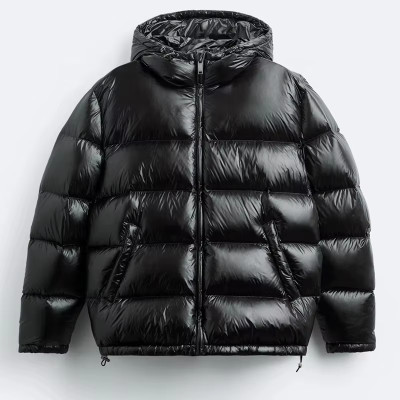
Quantity also matters in a scheduling sense. The MOQ is 50 pieces per style with mixed sizes and colors inside the minimum, so a small test order fits the same 25-40 day production window as a larger one. What changes with volume is the number of line days reserved: a 5,000 piece program occupies the line longer and must therefore be booked earlier. If your program uses stock fabrics and standard trims, plan for the 7 month end of the window; if it combines custom dye, branded components, and down certification, plan for 9 to 10 months and confirm component lead times in the quotation. A concrete example of a finished style in this category is our custom glossy pocket zipper puffer jacket, which shows how fabric finish choices and hardware details are specified before production scheduling begins.
Compressing the Timeline: What Works and What Does Not
A late start is recoverable, but only in specific ways
If you are reading this in June or July and need stock for the coming winter, the situation is recoverable, but the recovery options are specific and finite. The first step is to be honest about which parts of the calendar can compress and which cannot.
What works: choose stock fabrics instead of custom dye lots, limit the program to one or two styles, send a complete tech pack on the first message, pre-approve trims and colors against physical references, and confirm a production slot before you pay. Air freight can recover 2 to 4 weeks of the sea leg, which is why it is the standard rescue tool for late reorders; it costs significantly more than sea freight, so it belongs in the plan only when the sell-through margin justifies it. What does not work: skipping the pre-production sample, rushing RDS documentation, or expecting a custom dye lot to arrive faster than the mill can physically deliver.
Partial shipment is the most practical compromise for a genuinely late order. Ask the factory to ship a first portion by air so you have sellable stock for the season opening, with the balance following by sea. Factories that manage schedules properly can stage this, but only if the request is made before production starts, not after the goods are already packed. Our shipping options and delivery times FAQ compares sea and air options, shipping terms, and customs planning so you can cost the rescue correctly.
Sample fees are another reason to start early rather than late: development samples at Ginwen cost USD 50-200 per style depending on complexity, and the fee is deductible from the first bulk order. When a program is rushed, sample rounds multiply, and each round is both money and calendar time.
The Dates to Lock in Writing Before You Pay the Deposit
A written schedule turns an order window into a delivery date
The difference between a program that arrives on time and one that drifts is usually documentation, not factory speed. Before you pay the 30% deposit, ask for a dated schedule in writing and confirm that every date below is explicit. A factory that commits to specific weeks rather than "around 30 days" is a factory that manages its calendar.
- Development sample delivery date and the number of revision rounds included in the quoted price
- Material procurement window, with separate dates for stock fabrics and any custom-dyed or branded components
- Production start week and production end week, not just a total of 25-40 days
- Pre-production sample date and the sign-off deadline that releases production
- Final inspection date with the AQL 2.5 standard and third-party inspection option
- Ship date, port of loading, and the estimated arrival window for your destination
Payment terms at Ginwen are a 30% deposit and 70% balance before shipment, with the deposit reserving both the materials and the production slot. The balance is paid against the packing list, so the inspection and packing stages are natural checkpoints in the written schedule. Review each checkpoint against your own in-stock date: if any milestone slips by more than a few days, you still have time to decide between a revised sea date, a partial air shipment, or a smaller first delivery.
When you request a quotation, include the target in-stock date, destination port, quantities per style, color and size ratios, fabric and trim specifications, and your sampling status. With that information a factory can name the calendar week your order would start and the arrival month you should plan for. You can compare schedules across the Jacket Manufacturing FAQs to see how lead time, shipping, and quality topics fit together before you commit.
Final Answer: Order winter jackets 7 to 10 months before your peak selling season to meet it reliably. Work backward from your in-stock date: sampling takes 7-14 days per round, bulk materials 10-20 days, production 25-40 days, final QC 3-5 days, and sea freight 3-5 weeks, so a September stock date means confirming the order around April to May and starting planning in January to February. First programs need 9 to 12 months; reorders of approved styles are comfortable at 4 to 5 months. Orders placed from July to October run into the factory peak and need a confirmed production slot, a 2-4 week buffer, and a realistic air-freight fallback. Lock every milestone date in writing before paying the 30% deposit.
Planning a winter jacket program? Send your target in-stock date for a slot check.