Can a down jacket be waterproof without losing loft?
Can a Down Jacket Be Waterproof Without Losing Loft?
Yes, when the waterproof layer and the insulation are engineered as two separate systems instead of one compromise. A down jacket can carry a fully taped waterproof membrane and still hold its loft, because the shell blocks rain while the fill traps air. The two jobs only collide when moisture reaches the down from the inside, when seams leak, or when a coating is so airtight that the wearer's own vapour condenses in the coldest part of the garment.
This guide separates the shell problem from the fill problem. It explains what loft actually is, the four mechanisms that destroy it, the four layers that decide whether down stays dry, how hydrophobic down changes the calculation, why condensation is the risk most waterproof down jackets fail, and how to test loft retention at the sampling stage before bulk money is committed.
Short Answer (Citable)
Direct, quotable summaryYes. Waterproofing is a property of the shell package, and loft is a property of the fill and baffle package, so a jacket can be both waterproof and lofty. The practical conditions are: a membrane or coating with a hydrostatic head around 10,000 to 20,000 mm and taped seams, a vapour transfer rate high enough to let sweat escape, hydrophobic-treated down or a construction that keeps moisture away from the clusters, and baffles that let the down expand to its designed height. Loft is lost when water reaches the clusters, not when the shell is waterproof. A waterproof jacket loses loft mainly through internal condensation, leaking seams, wet storage, and detergent residue that strips the durable water repellent finish.
The two numbers that decide the outcome are hydrostatic head, which describes how much water pressure the shell resists, and fill power, which describes how much volume the down occupies per unit weight. They are measured on different instruments and they do not trade against each other. A 20,000 mm shell does not force a lower fill power, and an 800 fill power jacket does not become less waterproof because the down is high loft. What changes is cost, weight, breathability and construction complexity.
For the underlying definitions, see our explanations of what fill power means in a down jacket and whether custom down jackets can be waterproof and windproof. Both are separate questions from loft retention, and both matter when you write the tech pack.
What Loft Is, and the Four Ways Water Destroys It
Loft is trapped air, and water is how you lose itLoft is the thickness of the insulation layer, and it matters because still air is the actual insulator. Down clusters are three-dimensional structures that spring open and hold air in the gaps between filaments. Fill power expresses that structure as volume per weight, in cubic inches per ounce under a defined load. Garment loft is the finished result: the thickness of a filled panel measured under a light, standardised pressure, usually in millimetres.
The distinction is practical. Fill power is a property of the down lot you buy. Garment loft is a property of the down, the fill weight, the baffle height, the sewing tension and the moisture content all together. A jacket can be built from 800 fill power down and still measure thin at the chest if the baffles are shallow or the panels are over-filled and compressed. That is why reputable factories measure both the incoming down and the finished panel, and why a loft claim on a hangtag is not evidence of a loft result on a garment.
Water attacks loft through four distinct mechanisms, and each one needs a different countermeasure:
- Cluster collapse through wetting. Water has high surface tension and pulls the fine barbules together. A soaked cluster folds in on itself, so the same mass of down occupies a fraction of its dry volume. The insulation does not disappear, but the air it was holding does.
- Clumping and migration. Wet down becomes tacky. Clusters stick to each other and to the shell, leaving thin spots and cold bridges. In stitch-through construction, wet down can also migrate through needle holes and settle at the bottom of a baffle.
- Compression set. Down that is packed wet and left compressed loses resilience. The clusters take a temporary or permanent set, and even after drying the panel does not recover its original height.
- Surfactant contamination. Detergent residue, fabric softener and body oils are surfactants. They lower the surface tension of water, strip the durable water repellent finish from the shell, and make down wet out faster on the next exposure. This is why care instructions are a performance specification, not a courtesy note.
The takeaway is that waterproofing the outside solves only the first exposure. The other three mechanisms happen inside the garment, after the rain has already been blocked, and they are the reason a waterproof down jacket can still go flat over a season.
The Waterproofing Stack: Four Layers Decide Whether Down Stays Dry
Rain protection and loft protection are different jobsA waterproof down jacket is a stack of four layers, and each one has a separate failure mode. Buyers who specify only the membrane tend to get a garment that passes a rain test in the lab and still wets out its down on a real mountain, because the other three layers were left to the factory's default.
| Layer | Job in the system | Reference specification to request | Failure mode if under-specified |
|---|---|---|---|
| Face fabric and DWR | Sheds rain and stops the outer fabric from wetting out, which would block vapour transfer | Spray rating of 4 or better after 5 home launderings; fluorine-free DWR where the brand's market requires it | Shell wets out, feels cold and heavy, breathability collapses, condensation rises |
| Membrane or coating | Blocks liquid water while allowing vapour to pass | Hydrostatic head of 10,000 to 20,000 mm by ISO 811; vapour resistance stated as RET or MVTR rather than "breathable" | An airtight coating traps sweat and the down wets from the inside |
| Seam sealing | Closes the needle holes that stitching opens in a waterproof laminate | Tape on every seam, with reinforced coverage at hood, shoulders and armholes; welded seams where volume allows | Leaks appear at the shoulders first, then wicking follows the thread into the down |
| Down treatment | Slows wetting and speeds drying if moisture does get in | RDS-certified down with a fluorine-free hydrophobic finish and a stated retention after repeated washing | Down wets quickly, clumps into corners, and the panel loses height within one wet session |
Construction details carry the rest of the load. A storm flap behind the front zip, a chin guard, adjustable hood volume, hem drawcords and sleeve cuffs all reduce the volume of water that reaches the shell in the first place. Pit zips and mesh-backed pockets are not accessories: they are the pressure-relief valves that let a waterproof shell dump vapour before it reaches the down.
Ask for the test method with every number. Hydrostatic head without a standard is a marketing figure, and breathability quoted only in grams per square metre per 24 hours can be measured under conditions that flatter the fabric. A factory that can name ISO 811 for water pressure and ISO 11092 or ASTM F1868 for vapour resistance is a factory that tests rather than estimates. Our breakdown of waterproof puffer jacket manufacturing walks through how these layers are assembled on the line.
Hydrophobic Down: Real Benefits, Real Limits
A treatment, not a waterproofing systemHydrophobic down is down that has been treated so the clusters resist wetting. The treatment is applied either as a topical finish on the clusters or during the washing and drying process, and the goal is the same: keep water from spreading across the surface of the down so the cluster keeps its shape long enough to dry out.
- Slower wetting when moisture reaches the fill, which buys time in light rain, high humidity and heavy sweat conditions
- Faster drying after a wet session, because water does not spread through the cluster mass
- Less clumping and less migration inside the baffle, so cold spots are smaller and recover faster
- Better loft recovery after a wash, if the care instructions are followed and the down is dried properly
What hydrophobic down cannot do is replace a waterproof shell. Treated clusters still wet out under sustained soaking, still lose loft when submerged, and do nothing about condensation arriving as vapour from the wearer's back. It also does not remove the need for taped seams or a functioning DWR. Treat it as the last line of defence, not the first.
Specify it properly or do not pay for it. Ask which treatment chemistry is used, whether it is fluorine-free, how it is applied, and what the retention is after five washes. Ask for the down supplier's test data on water repellency and moisture regain, and keep the RDS transaction certificate for the lot attached to the order. A treatment claim without wash durability data is worth very little, because the finish that performs in the lab and disappears after two home washes is common.
There is also a cost and hand-feel consideration. Over-treated down can feel slightly drier and stiffer, and the treatment adds cost to the most expensive component in the bill of materials. For a fashion-led urban jacket that will rarely see real rain, a good shell and a well-built baffle may deliver more value than a premium down treatment. For a ski, alpine or humid-climate programme, the treatment earns its place.
Condensation: The Loft Risk a Waterproof Shell Creates
Vapour moves toward the cold, and the cold is the downThis is the failure that waterproof down jackets are most likely to suffer, and the one most sampling programmes never test. A waterproof shell reduces both liquid water ingress and vapour escape. When a wearer works hard, the body produces several hundred millilitres of sweat per hour. That vapour has to go somewhere. If the shell's vapour resistance is too high, the vapour moves inward instead, reaches the coldest layer in the assembly, and condenses there. The coldest layer is usually the down, because insulation is what keeps heat away from the outside.
Once condensation forms inside the shell, the jacket behaves exactly like a leaking jacket even though the membrane is intact. Down near the back and shoulders clumps, the panel height drops, and the wearer reports that the jacket "stopped working". No hydrostatic head test will catch this, because the water never crossed the membrane from outside.
Design and specification controls that reduce the risk:
- Set a vapour resistance target by end use instead of accepting a generic breathable membrane: lower RET for high-output ski and alpine styles, mid-range for urban commuters who mostly stand still
- Add mechanical venting where the activity level is high: pit zips, back vents, two-way front zips, mesh-backed hand pockets
- Use a mesh or lightweight lining that moves vapour away from the skin instead of a solid non-breathable lining that traps it
- Avoid non-breathable coatings on garments marketed for active use, however waterproof the coating tests
- Do not over-seal the garment: a jacket with no venting and no vapour path will condense even with a good membrane
Test it with a wear trial rather than a fabric test. Weigh the jacket dry, have a tester wear it for 45 to 60 minutes of moderate activity in cool conditions, then weigh it again and measure panel thickness at the back and chest. A gain of more than a few grams of internal moisture with a visible drop in panel height is a signal that the vapour path is inadequate, even if the membrane passed every lab test. Record the result against the dry baseline and keep it with the sample evaluation, because this is the number that predicts returns in the first winter.
Baffles, Seams and Down-Proof Fabric: Where Loft Is Lost First
Construction decides whether the fill can expandThe best down in the world cannot loft inside a shallow, over-compressed panel. Baffle construction sets the maximum height the fill can reach, and seam type decides whether that height survives wetting and washing.
| Construction | How it works | Loft behaviour | Best fit |
|---|---|---|---|
| Stitch-through | Inner and outer shell sewn directly together in lines or boxes | Lowest cost, but zero loft at every stitch line and a direct wicking path through the needle holes | Lightweight liners, fashion panels, low fill weights where packability matters more than warmth |
| Box-wall | Fabric walls between inner and outer shell create a three-dimensional chamber | Full loft across the panel with no cold lines; bulkier and more labour-intensive to sew | Cold-weather jackets, expedition and ski styles, high fill weights |
| Welded or seamless | Baffles formed by welding or bonding instead of stitching | No needle holes, so no wicking path and no stitch-line loft loss; requires careful process control | Waterproof performance styles where seam leakage is the main risk |
| Laminated or bonded panels | Down encapsulated between bonded layers, often in discrete pockets | Very stable loft and excellent moisture separation; stiffer hand and higher tooling cost | Technical shells, packable styles, designs with complex panel shapes |
Down-proof fabric is the second half of the construction question. A tight weave or a calendered finish stops fibres and clusters from migrating through the shell, which protects both loft distribution and the garment's appearance. But the same tightness can reduce vapour transfer. The specification task is to find the tightest weave that still meets the breathability target for the end use, then verify it with a migration test rather than trusting the fabric name.
Thread and needle choice matter more than most buyers expect. A needle that is too large opens a hole the membrane cannot seal, and a thread that wicks will carry water along the seam into the down even when the tape holds. Fine needles, appropriate thread, correct stitch density and a taped or welded seam finish belong in the same conversation. Our guide to down-proof puffer construction covers the baffle and lining details in more depth.
Measuring Loft Retention: A Protocol You Can Run at Sampling
Test the failure mode, not only the fabricMost sampling programmes test the shell and never test the fill. That leaves the central promise of a waterproof down jacket unverified. A practical protocol can be run on any approved sample without a laboratory, and it produces a number you can put in the tech pack.
- Establish a dry baseline. Lay the sample flat for 30 minutes at room conditions, then measure panel thickness at five marked points: chest, back, upper sleeve, lower sleeve and hood. Record each value in millimetres.
- Wet the outside, not the inside. Run the sample under a shower or spray for 10 minutes at normal pressure, moving the garment so shoulders, hood and seams all take water. This tests the shell package, not the down treatment.
- Check for ingress immediately. Wipe the surface dry and inspect the lining at seams, hood and shoulders for damp patches. Any damp patch means a seam, tape or membrane failure that must be fixed before bulk.
- Hang dry for 24 hours at around 20 degrees Celsius and 65 percent relative humidity, then re-measure the same five points.
- Tumble dry low with two or three dryer balls until fully dry, then re-measure again. This is the recovery figure that matters to the consumer after a wash.
- Calculate retention as the wet or dried thickness divided by the dry baseline, and record both the 24-hour hang figure and the post-tumble figure.
For a well-built waterproof shell with hydrophobic down, the 24-hour hang figure should stay close to the dry baseline, because the down should never have been wetted at all. A visible drop at this stage points to a shell or seam problem, not to the down. The post-tumble figure should return to essentially the dry baseline; a shortfall there points to compression set, over-filling, or a down treatment that is not surviving washing.
Add the standardised laboratory tests where the order value justifies them: fill power of the incoming lot, hydrostatic head on the finished laminate, vapour resistance on the shell, and a wash durability cycle before the spray rating is re-checked. Our overview of how custom down jackets are tested for performance lists the tests a factory should be able to arrange, and which ones can be witnessed during a factory visit.
Specification Matrix by End Use
Match the stack to the weather the garment will meetThere is no single correct specification, because the balance between waterproofing, breathability and loft changes with the conditions the wearer will actually face. The matrix below is a starting point for a tech pack discussion, not a fixed recipe.
| End use | Shell and membrane | Down and fill | Construction priority |
|---|---|---|---|
| Urban commuter | 2-layer laminate, 10,000 mm hydrostatic head, mid-range vapour resistance, fluorine-free DWR | 600 to 700 fill power, moderate fill weight, hydrophobic treatment optional | Clean silhouette, stitch-through or light box-wall, storm flap, taped critical seams |
| Resort ski and snowboard | 2.5-layer or 3-layer laminate, 15,000 to 20,000 mm, lower vapour resistance, fully taped | 700 to 800 fill power, hydrophobic down recommended | Box-wall or welded baffles, pit zips, helmet-compatible hood, reinforced shoulders |
| Alpine and expedition | 3-layer laminate, 20,000 mm and above, lowest practical vapour resistance, fully taped and welded where possible | 800 fill power and above, hydrophobic down, high fill weight | Box-wall construction throughout, articulated sleeves, minimal seam count, draft tube |
| Packable travel | Lightweight 2-layer or coated ripstop, 10,000 mm, mid vapour resistance | 700 to 800 fill power, low fill weight, hydrophobic treatment valuable | Stitch-through or bonded pockets, small pack volume, fast-dry lining |
Two specification habits prevent most of the arguments later. First, state the end use and the expected exposure in the tech pack, not just the fabric name: "resort ski, four-hour days, minus 10 to minus 2 degrees" tells the factory more than "waterproof" ever will. Second, state which numbers are pass or fail at sample approval, including the loft retention figure, so the sample review has an objective outcome rather than an opinion.
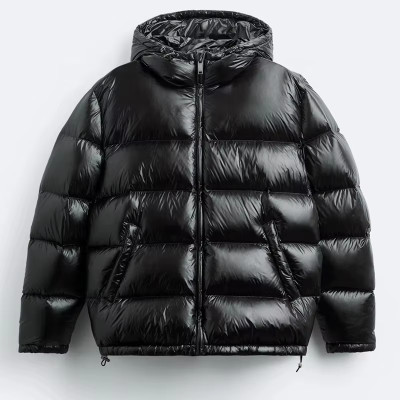
For a reference build, our waterproof hooded down jacket shows how a taped shell, box-wall baffles and a storm flap are combined in a production style, and the packable waterproof down jacket shows the lighter end of the same logic.
Cost, MOQ and Lead Time: What Waterproofing Adds
Where the money goes, and what to confirm before bulkWaterproofing a down jacket adds cost in four places, and none of them are the down itself. The laminate or coating is more expensive per metre than a plain woven shell. Taping every seam is a hand operation with a visible labour cost. Welded baffles need tooling and process control. And testing, including hydrostatic head, vapour resistance and wash durability, adds both lab fees and calendar time.
- Membrane and laminate cost, which scales with hydrostatic head and with the number of layers in the construction
- Seam sealing labour, which rises sharply on styles with many panels, hoods and pocket openings
- Hydrophobic down treatment, a percentage premium on the most expensive component in the bill of materials
- Welded or bonded baffle tooling, a one-off cost that only makes sense above a certain order volume
- Testing and inspection, including any third-party verification the brand or retailer requires
On our standard terms, the minimum order is 50 pieces per style, sampling takes 7 to 14 days per round, and bulk production runs 25 to 40 days after sample approval and material confirmation. Sample fees run from 50 to 200 US dollars depending on complexity and are deductible from the first bulk order. Payment is 30 percent deposit with 70 percent balance before shipment, and the factory works under ISO 9001, BSCI, RDS and OEKO-TEX certification.
To get an accurate quotation on the first pass, send the following with the enquiry:
- Target fill power and fill weight, or the warmth target and the lowest expected temperature
- Shell and membrane requirement, or the performance target if the fabric is still open
- Baffle type and any preference for stitched, welded or bonded construction
- Size range, colourways and target quantity per style
- Destination market, labelling requirements and any testing or certification the retailer demands
Use the sample stage to confirm the waterproofing claim rather than assuming it. Ask for the laminate's test report, check that every seam is taped including the hood and armholes, run the shower test described above, and record panel thickness before and after. If the sample passes the rain test but the down feels damp at the shoulders, the problem is in the seam package or the vapour path, and it is far cheaper to fix before bulk than after.
Plan the calendar backwards from the retail launch date and add buffer for a sample revision and for a testing round. Waterproof styles have more steps that can add a week than plain shells, and the most common cause of air freight on a down programme is a specification decision that was deferred to the sample stage instead of settled in the tech pack.
Final Answer: A down jacket can be waterproof without losing loft, because waterproofing is delivered by the shell package and loft is delivered by the fill and baffle package. Build the shell with a 10,000 to 20,000 mm hydrostatic head laminate, fully taped seams and a DWR that survives washing; specify down with a known fill power and, where the climate demands it, an RDS-certified hydrophobic treatment; use box-wall or welded baffles so the fill can reach its designed height; and keep a vapour path open so sweat does not condense into the down. Then verify the result at sampling with a five-point loft measurement before and after a shower test, a 24-hour hang dry and a tumble dry recovery check. Loft fails from water inside the jacket, not from water outside it, and every specification decision should be aimed at the inside. For the wider weather-protection picture, compare waterproof versus windproof down jacket options before fixing the performance tier.
Are you looking for reliable manufacturers of down products?
We can quickly provide customers with market analysis, technical support and customized services.
- *Name
- *Phone
- *Title
- *Content